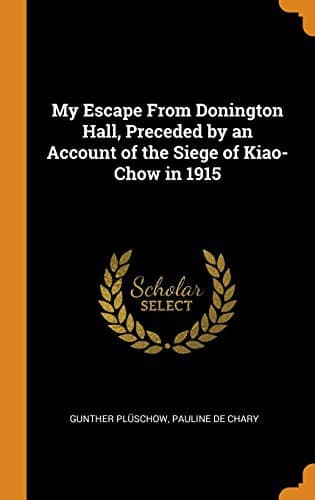
My Escape from Donington Hall, Preceded by an Account of the Siege of Kiao-Chow in 1915Plüschow, Gunther
History
My Escape from Donington Hall, Preceded by an Account of the Siege of Kiao-Chow in 1915
Plüschow, Gunther
Prisoner-of-war escapes; World War, 1914-1918 -- Personal narratives, German; World War, 1914-1918 -- Prisoners and prisons, British
I soon got over the first pleasant emotion of bombing. My time was
fully occupied apart from it, and the results did not justify the time
I lost.
I often met my enemy colleagues in the air. I did not hanker for these
meetings, for I could do little with my slow, laboriously climbing
Taube against the huge biplanes which carried a crew of three men.
Above all, I dared not forget that my chief object was reconnoitring,
and after that to bring back my machine to Kiao-Chow in good condition.
Once I was busily engaged on my observations, when my aeroplane began
to pitch and toss. I thought this was due to bumps in the air, caused
by the many steep and rugged mountains of this country which made
flying extraordinarily difficult. Without even looking up, I went on
taking observations, only grasping the control-lever with one hand in
order to keep the aeroplane steady.
After my return I was informed, to my great surprise, that an enemy
plane had flown so closely on top of me that they thought I should be
shot down.
Next time I was more careful. And on sighting one of my enemy
colleagues I followed and shot him down with my Parabellum pistol,
after firing thirty times.
A short time afterwards I nearly shared his fate. I was only at an
altitude of 1700 metres, and in spite of the greatest efforts I could
not get any higher. I was just above the enemy seaplane station as one
of the great biplanes started. I now carried out my reconnaissance,
thinking to myself: “Well, he can bestir himself until he gets up as
high as I!”
But after forty minutes, when I looked on my left over the plane, I saw
the enemy already gaining on me at a distance of only a few thousand
metres. This meant to be on guard and climb higher. But my Taube simply
refused to budge, and I could not gain another yard. A quarter of an
hour only elapsed before the other chap had outdistanced me, and was
coming diagonally across my trail, trying to cut me off from the road
to Kiao-Chow.
It was now a matter for betting who would first reach Kiao-Chow, but I
won the race. When I returned to my aerodrome I simply dived down, and
no sooner did I reach the ground than bombs were bursting all around
us.
It is extraordinary how they sometimes find their mark!
Strict orders had been given at Kiao-Chow that everybody should make
for cover as soon as an enemy airman was sighted. We had only two
casualties—a non-commissioned officer and a Chinese. And that was
quite marvellous enough. On my aerodrome I had about one hundred
coolies, and they always sped to safety. One day, however, a native
remained standing in the middle of the ground, all on his lonesome,
staring at the large bird. Bang! A bomb hurtled through the air and
exploded but a few paces away. The poor devil was badly hit. To have
really bad luck there is no easier way than to be on the spot where
shells and other heavy missiles are flying about.
CHAPTER VI
HURRAH!
Public-domain text, read in full here on John Shaqi.
Reviews
Reviews
No reviews yet
Be the first to share your thoughts on this work.
Join the Discussion
Join the discussion
Sign in to leave a comment or review.
Sign InorCreate an account