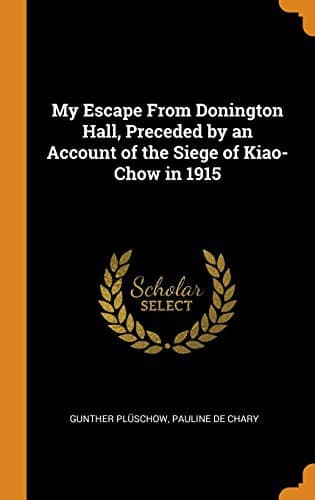
My Escape from Donington Hall, Preceded by an Account of the Siege of Kiao-Chow in 1915Plüschow, Gunther
History
My Escape from Donington Hall, Preceded by an Account of the Siege of Kiao-Chow in 1915
Plüschow, Gunther
Prisoner-of-war escapes; World War, 1914-1918 -- Personal narratives, German; World War, 1914-1918 -- Prisoners and prisons, British
Two evenings before he had been out in a gallant endeavour to lay mines
on the track of the Japanese ships. To-day he was going to fulfil his
last and most difficult task—to break through the line of the enemy
torpedo-boat destroyers and attack one of the enemy ships. It was a
clear night, and there would be no moon after ten. The time came. Ten
struck, then 10.30—the tension became unbearable. Nothing could be
seen of S.90. Suddenly—it was eleven—we perceived a narrow, grey
shadow which carefully moved on the water under the Pearl Mountains.
And soon our sharp sailors’ eyes recognized the shape of the torpedo
boat. “Good luck to your brave men!” Our hearts accompanied them with
our warmest wishes. The boat disappeared from our sight, and soon the
dangerous moment was at hand, when they would have to break through
the enemy lines. Our eyes were glued in fascination on the open sea,
expecting the flashing of the searchlights and the thunder of the guns
at any moment.
But all was silence.
It was midnight. Another half-hour sped by—we breathed more easily,
for the enemy was still in ignorance of the coming attack. By this time
our boat must have reached the bulk of the fleet. The minutes turned
into hours. No one spoke.
Suddenly at 1 a.m., far away towards the south on the open sea, a huge
fire-column, and then from all sides the lurid, groping fingers of the
searchlights and a distant muttering and vibrating.
Hurrah! That was the work of S.90. And already at 1.30 we received the
following wireless:
“Have attacked enemy cruisers with three torpedoes, registered three
hits. Cruiser blew up at once. Am hunted by torpedo-boat destroyers,
return Kiao-Chow cut off, trying escape south, and, if necessary,
shall explode boat.
BRUNNER.”
This wire is sufficient praise for Commander, officers and crew.
A few weeks later, without premonition, I met the S.90 at Nanking—but
that is another story.
CHAPTER VII
THE LAST DAY
THE siege progressed according to plan. The Japanese dug themselves in
ever closer; they brought up more and more heavy guns, and on several
occasions large bodies of Japanese infantry made night attacks on our
infantry positions—to be, however, repulsed each time. After this they
subjected the latter and the wire entanglements in front of them to
continuous fire, which ceased neither by night nor by day. Our guns,
too, were never silent, but unfortunately we had to go slow on account
of our remaining ammunition. The extraordinary length of the siege, the
never-ceasing artillery fire, and the terrible tension under which we
lived, began to tell on us. My own nerves were getting out of hand.
I could no longer force myself to eat, and sleep had become impossible.
When I shut my eyes at night I immediately saw my map, and below me
the Protectorate with its enemy trenches and positions. My head swam,
and my ears ached from the whirl of the propeller, and I could hear,
over and over again, the words of the Chief of Staff:
Public-domain text, read in full here on John Shaqi.
Reviews
Reviews
No reviews yet
Be the first to share your thoughts on this work.
Join the Discussion
Join the discussion
Sign in to leave a comment or review.
Sign InorCreate an account