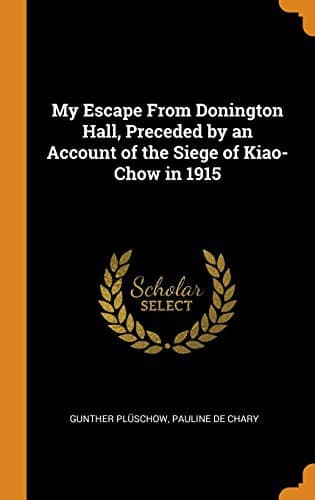
My Escape from Donington Hall, Preceded by an Account of the Siege of Kiao-Chow in 1915Plüschow, Gunther
History
My Escape from Donington Hall, Preceded by an Account of the Siege of Kiao-Chow in 1915
Plüschow, Gunther
Prisoner-of-war escapes; World War, 1914-1918 -- Personal narratives, German; World War, 1914-1918 -- Prisoners and prisons, British
At night I went up to the hill-top, where my friend, Oberleutnant
Aye, had been holding out for weeks, with his small battery, under
most severe shell-fire. From there one had a magnificent view of
Kiao-Chow and its surroundings. I sat for some time on the highest
peak, fascinated by the panorama at my feet. Below us a sea of fire,
with flashes of lightning from the guns thundering across space, and
like a golden thread stretched from sea to sea the yellow rifle and
machine-gun fire. Right over my head screamed, swished and whistled
thousands of shells, sweeping closely over the hill-top, bent on
reaching their targets. Behind me our heavy howitzers roared their
last message, and in the distance from the farthest southern point of
Kiao-Chow the 29-centimetre guns of Fort Hstanniwa poured out their
swan song.
Harrowed to the depths of my soul, I returned to Aye, and after taking
a hearty leave of him, carrying with me all his good wishes for my
venture, I left him, after shaking him warmly by the hand.
I was the last officer in Kiao-Chau to do so, for he fell a few hours
later in the heroic but unequal fight against the Japanese, he and his
gallant little band preferring death to surrender. A truly shining
example of noble heroism.
I spent the remaining hours with my four brave helpers, waiting in
readiness near my machine so as to be able to carry out my orders at a
moment’s notice should the Japanese break through.
On the 6th of November 1914, in the early dawn, with the moon still
shining, my aeroplane stood clear for the start, and my propeller gaily
hummed its morning hymn.
There was no more time to lose. The aviation field had become extremely
uncomfortable through the continuous shell and shrapnel fire.
Once more I examined my machine, shook hands with my men, stroked the
head of my faithful dog, then I opened the throttle and my Taube shot
like an arrow into the night.
Suddenly, as I was just about 30 metres above the centre of the
aerodrome, my machine received a fearful jar, and I was only able
to prevent her crashing downwards by putting forth all my strength.
An enemy grenade had just burst, and the air-pressure caused by the
detonation nearly sent me to the ground. But, thank goodness, a big
hole in my left plane caused by a shell-splinter was the only damage.
The usual hail of shrapnel followed—my last farewells from the Japs
and their English Allies.
When I was high enough I turned round once more to look at our dear
little Kiao-Chow, which had suffered and was still to suffer so much.
Our beloved second country—Paradise on earth.
Two lines of fire, facing each other, were clearly distinguishable,
and the faint roar of guns could be heard—sure forerunners of renewed
attack and desperate defence.
Would we be able to ward it off for the third time? I waved my hand
towards Kiao-Chow! Farewell, my faithful comrades, fighting down there!
Public-domain text, read in full here on John Shaqi.
Reviews
Reviews
No reviews yet
Be the first to share your thoughts on this work.
Join the Discussion
Join the discussion
Sign in to leave a comment or review.
Sign InorCreate an account