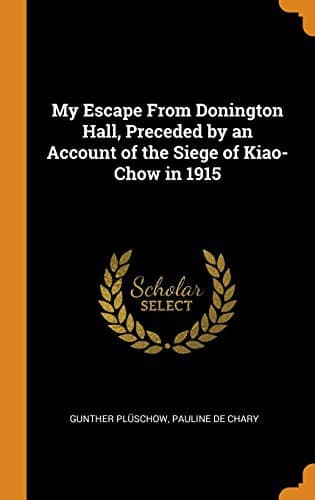
My Escape from Donington Hall, Preceded by an Account of the Siege of Kiao-Chow in 1915 — John Shaqi
My Escape from Donington Hall, Preceded by an Account of the Siege of Kiao-Chow in 1915Plüschow, Gunther
History
My Escape from Donington Hall, Preceded by an Account of the Siege of Kiao-Chow in 1915
Plüschow, Gunther
Prisoner-of-war escapes; World War, 1914-1918 -- Personal narratives, German; World War, 1914-1918 -- Prisoners and prisons, British
Who could have foreseen this? A short six months hence these same
adversaries opposed each other in a terrible game, which admitted but
of two issues—victory or death. At the battle of Coronel the German
bluejackets sent the English flagship _Good Hope_ to her doom at the
bottom of the Pacific in twenty-seven minutes.
But on that day none knew of the events to come and, united by bonds of
sincere friendship, the German sailors invited their English guests to
their cantonments. Two days later the English Squadron left our port
followed by our Cruiser Squadron under Admiral Count von Spee.
The flags fluttered gaily in the wind, conveying the signals of the two
admirals in command: “Farewell—until we meet again!”
Who could foresee that it would be at Coronel?
Immediately after my arrival, and after I had reported myself
officially, I looked round for my aeroplane, in hopes of being able to
show the amazed citizens of Kiao-Chow my beautiful giant bird. But——!
I had to curb my eagerness, for my machine was sailing jauntily round
India and the steamer only due in July. “What can’t be cured must be
endured,” I said to myself, and now had plenty of time to look round
Kiao-Chow and to choose a house. A delightful little villa, quite close
to the flying-ground, stood vacant, and I promptly took possession of
it with my new comrade, Patzig. I had everything now to make me happy:
my excellent billet at Kiao-Chow—this paradise on earth—work after my
own heart, and, to cap it all, this charming residence, perched high
on an eminence, with a lovely view on to Iltis Place and the distant,
dark blue sea. Apart from this, I belonged to the Cavalry Detachment,
and three happy years lay before me. Who could be more contented
than I? I now set about arranging my house. I had a great number of
plates on interior decoration, and with these I visited a Chinese
cabinet-maker and ordered the furniture. It is marvellous with how much
skill the Chinese are able to imitate our models, in what a short time,
and how cheaply. When, four weeks later, everything was shipshape,
the different pieces standing in their proper places, and the whole
house shining with cleanliness, the masters of the house proudly took
possession of their new abode. Nothing was lacking. Even servants were
provided. If a European wishes to stand well with the Chinese, he must
surround himself with a considerable number of Chinese servants; and
one may affirm it is practically the moral duty of every European to do
so.
Maurice, the cook, in his lovely blue silken Ishang; Fritz, the Mafu
(groom), a perpetual grin on his face, but very concerned about the
welfare of his horses; Max, the gardener, as lazy as a slug; and
August, the pert little “boy,” composed our staff.
To this must be added “Herr” Dorsch and “Herr” Simon.
These two gentlemen were our batmen, who took the fullest advantage of
the custom of the Far East, that a European must do no manual labour in
the presence of a Chinese.
Public-domain text, read in full here on John Shaqi.
Reviews
Reviews
No reviews yet
Be the first to share your thoughts on this work.
Join the Discussion
Join the discussion
Sign in to leave a comment or review.
Sign InorCreate an account