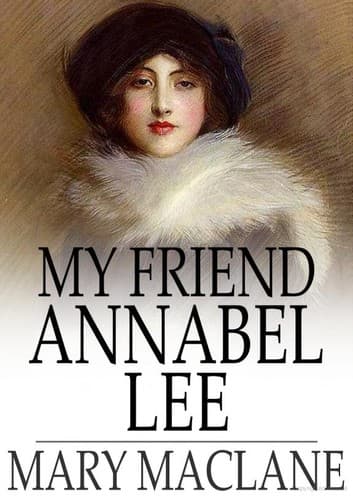
MacLane, Mary, 1881-1929; Women authors, American -- Biography
“For the idea is that in all one’s contemplation, when one is a
goose-girl, one should contemplate anything and everything except
the being and condition of a goose-girl.
“But a better idea still,” said my friend Annabel Lee, “would be to
not contemplate at all, you know, but eat the radishes and other
things, under the yew-tree, and rejoice.
“At any rate,” said my friend Annabel Lee, “we need not contemplate
_now_--what with these two little fishes and these green, crisp
leaves.”
She picked up her small silver fork again and went to eating
lettuce.
And presently we both lifted our mugs of good ale and drank to that
which would be a better idea still.
XX
CONCERNING LITTLE WILLY KAATENSTEIN
I had one day given my friend Annabel Lee the bare outline of the
facts in a case, and I asked her if she would kindly make a story
from it and tell it me.
So my friend Annabel Lee told me a little story that also runs in
my mind, someway, in measure and rhythm.
“There lived in a town in Montana,” said my friend Annabel Lee,
“not very long ago, in a quiet street, a family of that sort of
persons which is called Jewish. And it is so short a time ago that
they are there yet.
“Their name was Kaatenstein.
“There was Mrs. Kaatenstein and Mr. Kaatenstein and the four
young children, Harry Kaatenstein and Leah Kaatenstein and Jenny
Kaatenstein and little Willy Kaatenstein.
“And there was the hired girl whose name was Emma.
“And there was Uncle Will, Mrs. Kaatenstein’s brother, who lived
with them.
“Mrs. Kaatenstein was short and dark and sometimes quite cross, and
she always put up fruit in its season, with the help of the hired
girl, and the kitchen was then very warm.
“And Mr. Kaatenstein was also dark, but was a tall, slim man, and
was kind and fond of the children, especially the two little girls.
Mrs. Kaatenstein was fond of the children also, but mostly fond of
the two boys.
“And Harry Kaatenstein was much like his mother, only he was not
so dark, and he was ten years old.
“And Leah Kaatenstein was ten years old also--the two were twins--and
she had an eye for strict economy, and wore plain gingham frocks,
and had a long dark braid of hair, and played with very homely
dolls.
“And Jenny Kaatenstein was seven years old and was most uncommonly
fat, and was rarely seen without a bit of unleavened bread in her
hand--for the children were allowed to have all that they wanted of
unleavened bread. They did not want very much of it, except Jenny.
And they all preferred to eat leavened bread spread with butter
and sprinkled with sugar--but they couldn’t have as much as they
wanted of that.
Public-domain text, read in full here on John Shaqi.
Reviews
Reviews
No reviews yet
Be the first to share your thoughts on this work.
Join the Discussion
Join the discussion
Sign in to leave a comment or review.
Sign InorCreate an account