Produced by David Garcia, Eric Eldred, Charles Franks, and
the Online Distributed Proofreaders Team.
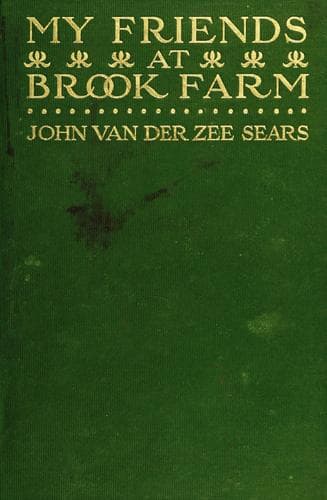
[Illustration]
My Friends at Brook Farm
by John Van Der Zee Sears
TO MY FRIEND
JOSEPH HORNOR COATES, Esq.
OF PHILADELPHIA
Contents
Chapter I. THE OLD COLONIE
Chapter II. FRIEND GREELEY
Chapter III. A STRANGER IN A STRANGE LAND
Chapter IV. A BAD BEGINNING
Chapter V. A GOOD ENDING
Chapter VI. ENTERTAINMENTS
Chapter VII. THE SCHOOL
Chapter VIII. ODDMENTS
Chapter IX. FOURIER AND THE FARMERS
Chapter X. UNTO THIS LAST
ILLUSTRATIONS
JOHN VAN DER ZEE SEARS
HORACE GREELEY
RALPH WALDO EMERSON
“THE HIVE”
CHARLES A. DANA
THE PAGEANT
A PIONEER KINDERGARTEN
NATANIEL HAWTHORNE
[Illustration: Portrait of the Author: John Van Der Zee Sears]
CHAPTER I.
THE OLD COLONIE
In May, 1624, the Dutch packet New Netherlands sailed up the Hudson
River to the head of navigation, bringing a company of eighteen
families under the leadership of Adrian Joris. The immigrants landed at
a little trading post called Beaverwick kept by one Tice Oesterhout, a
pioneer hunter, married to a Mohawk Squaw. In a few days a party of
Indians, probably Mohawks, waited on the newcomers and politely made
inquiry as to their object in entering upon Indian lands without notice
or permission; Tice Oesterhout and his wife acting as interpreters.
Joris replied that they came in peace and hoped to abide in peace on
friendly terms with the Indians. He was told that he and his people
would be welcome if they joined the universal peace union of the
Iroquois, and not otherwise. This proposition the settlers agreed to by
acclamation. In due course the General Council of the Five Nations
accepted the Colony as a member of the Iroquois Federation. Joris was
recognized as the Civil Chief of the little community, and, as he was a
Walloon, his people became the Walloon Nation of the Great Peace
Alliance. The Great Peace was the treaty forming the basis of the
Iroquois Federation. The Colonists, instead of making a treaty with the
Indians, gave their adhesion to one already made, thereby securing
safety and a practical monopoly of the fur trade on the upper Hudson.
They sent annual presents to the Iroquois General Council, which were
doubtless received as tribute in recognition of sovereignty, but the
Walloon Nation did not seem to care very much about the sovereignty
business so long as the fur business continued to prosper, as it did
for the next half century.
Two score or so of Walloons did not constitute a very formidable nation
but the men were reinforced by the women who had an equal voice not
only in local affairs but in the General Council of the Federation.
Public-domain text, read in full here on John Shaqi.
Reviews
Reviews
No reviews yet
Be the first to share your thoughts on this work.
Join the Discussion
Join the discussion
Sign in to leave a comment or review.
Sign InorCreate an account