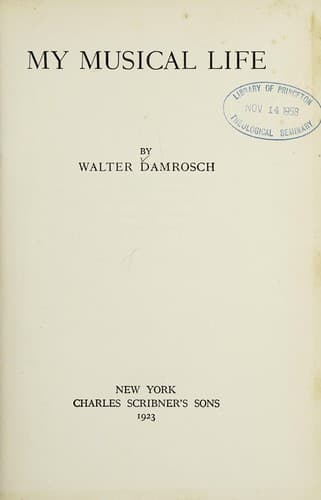
Conductors (Music) -- United States -- Biography; Damrosch, Walter, 1862-1950
The theatre had been very cleverly placed in the doorway between two
rooms, but as the piano was in the same room where the audience sat, I
had to rush backward and forward continually. For instance, when Gustav
pulled the curtain to disclose the depths of the Rhine, I played the
Rhine music, then would creep back under the table on which the theatre
was placed and help him manipulate the Rhine Maidens. Then I would rush
back again to play the music accompanying the awakening of the Gold and
so on until the change of scene when, as the rising sun shines upon the
mighty walls of Walhalla, I would reproduce the stately harmonies of the
Walhalla motive.
As I look back on it now, it must have been an absolutely crazy
performance, but the audience was hugely delighted and contributed so
liberally that my co-director and I had a surplus with which to begin
preparations for another play.
Some parents on reading this may think that all this was a huge waste of
time, but I cannot agree with them. Quite apart from the fact that it
taught me a good deal in the use of the brush, it was a great stimulus
to the imagination and a welcome outlet for the desire all children have
to live in a make-believe world of fancy. At any rate, Gustav Schirmer
and I can claim that we were the first to produce Wagner’s “Rhinegold”
in America, and it is possible that this was the germ for my decision
eighteen years later to form the Damrosch Opera Company solely for the
purpose of producing Wagner throughout America.
The dolls’ theatre was, however, not my only diversion from my school
and musical studies.
At one Christmas my father and mother gave me a very complete tool
chest, with which I fashioned, among other things, a dolls’ house for my
sisters and quite a little fleet of boats. I remember one three-master,
about three feet in length, the wood for which I obtained from a foreman
at the Steinway piano factory, then situated on Park Avenue. This
three-master with all sails set won several races for me on the pond in
Central Park.
In those days, Central Park was considered very far uptown, and where
now the palaces of millionaires flank its borders, Irish squatters lived
in improvised huts around which goats would gain a meagre livelihood
from the rocks stretching on all sides. These squatters established a
kind of lien on the land, which I believe was recognized as having some
legal force when the property became more and more valuable and the
owners began to grade the land for residential purposes.
Public-domain text, read in full here on John Shaqi.
Reviews
Reviews
No reviews yet
Be the first to share your thoughts on this work.
Join the Discussion
Join the discussion
Sign in to leave a comment or review.
Sign InorCreate an account