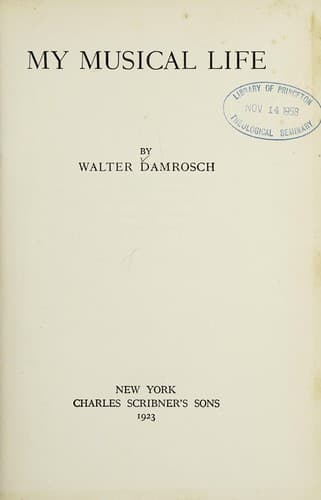
Conductors (Music) -- United States -- Biography; Damrosch, Walter, 1862-1950
In Handel’s time he himself usually sat at the organ and filled in with
masterly improvisations many of the harmonies for which in his score he
had written only the bass, with figures indicating the harmonies which
the organist should improvise. Since then various musicians have
endeavored to supply these harmonies in permanent fashion by writing
them for other instruments in the orchestra, principally for clarinets
and bassoons. As most concert-halls are but poorly supplied with organs,
these arrangements offered a kind of substitute, and the one most in use
was that of Robert Franz. He was a German composer of very lovely songs,
and a great admirer of Handel, but, curiously enough, his arrangements
were very bad and not in keeping with the Handelian spirit. Mozart also
had written accompaniments to supply the missing harmonies for a
performance of the “Messiah” in Vienna at a hall in which there was no
church organ. His additions, especially in the air “The people that
walked in darkness,” are of such transcendent beauty that when I
proceeded in my work of restoring the Handelian orchestra to its
original form my courage failed me completely as I came to this air. It
was as if one master had found a painting by another and had encircled
it in a frame of such beauty as to enhance the value of the original
picture. I could not bear to disturb it, but the clarinets and bassoons
of Robert Franz were thrown out by me with great gusto.
Another novel and interesting feature of our festival was a scenic stage
performance of a charming pastoral of Handel’s “Acis and Galatea.” This
proved to have dramatic qualities which in their appeal seemed way
beyond that of the many Italian operas which Handel has written. The
cast was excellent. The part of _Galatea_ was sung by Madame de Vere, a
charming coloratura singer; the shepherd _Acis_ by William Rieger, one
of our best young concert tenors; and _Polyphemus_, the giant, by that
master artist, Emil Fischer. The scene represented a landscape of
classic beauty, and all the participants were clad in very charming
Greek shepherd costumes. The scene in which _Polyphemus_, coming upon
the shepherd lovers, lifts a huge rock and in jealous rage kills Acis,
was done with such dramatic intensity as to thrill our audiences. The
performance was a real event, as this work had perhaps not been given in
its dramatic form since the time of Handel; but, curiously enough, it
roused but little interest, for, whereas all the other performances of
the festival were crowded to the doors, we had but half an audience at
our two performances of the pastoral. It came about twenty years too
early, and I think that to-day, especially if given under the auspices
of the Metropolitan Opera, it would arouse wide-spread interest.
Public-domain text, read in full here on John Shaqi.
Reviews
Reviews
No reviews yet
Be the first to share your thoughts on this work.
Elsewhere in the archive
Join the Discussion
Join the discussion
Sign in to leave a comment or review.
Sign InorCreate an account