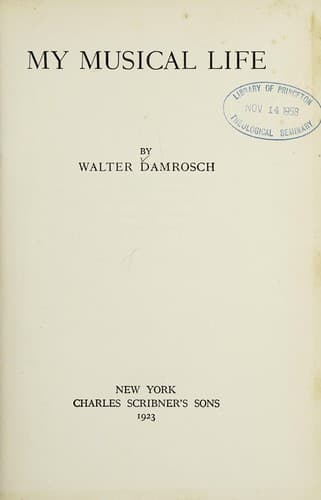
Conductors (Music) -- United States -- Biography; Damrosch, Walter, 1862-1950
This spring (1922) I was in Munich and the town was in great excitement
over the approaching performance of Handel’s “Acis and Galatea” in
dramatic form. Their conductor, Bruno Walter, said to me: “We are very
proud of this stage performance, as it is the first since Handel’s
time.” He was amazed and, as he told me, much chagrined when I informed
him that I had given it in New York nearly thirty years ago. He gave it
a beautiful performance. I had costumed my singers in classic Greek, but
the Munich stage director had given the work an additional and rather
piquant flavor by dressing the singers and dancers as in Handel’s time,
when all performers, in no matter what age their plays were supposed to
take place, wore the costumes and huge periwigs of their own period.
In the summer of 1898 we were much excited by the dramatic accounts of
Admiral Dewey’s victory in Manila Bay, and it seemed to me fitting to
celebrate it by composing a “Te Deum” for soloists, chorus, and
orchestra. In order to give my “Manila Te Deum” an appropriate
character, I used several of the bugle-calls of the American army and
navy as a _cantus firmus_, around which I wove the fugal developments of
the voices of the chorus. In the last chorus, “O Lord, in thee have I
trusted; let me never be confounded,” I used the “Star-Spangled Banner”
in similar fashion.
The work received its first performance at a concert of the Oratorio
Society, December 3, 1898, and marked the introduction of my brother as
regular conductor of the society. The following spring I was invited to
conduct it at a Dewey celebration in Chicago, and on February 6, 1900, I
directed it again at a special performance given in Carnegie Hall, the
proceeds of which were to be used toward the building of an arch in
honor of Admiral Dewey. This arch, however, was never built, and the
several thousand dollars which resulted from our concert were finally
donated by the Dewey Arch Committee to a philanthropic purpose. Our two
guests of honor at this performance were Admiral Dewey, in a box on one
side of the hall, and Theodore Roosevelt, at that time Governor of New
York, in a box on the other side. Roosevelt was to make an appropriate
address, and as the victor of Manila Bay was present and the entire
occasion was one of jubilant admiration for our navy, we expected one of
Roosevelt’s most flaming patriotic addresses on the glories of the
American navy. But, alas, that evening his mind was completely occupied
with things nearer home, and after a few very courteous remarks about my
music, he launched forth into a terrific speech on the Street Cleaning
Department of New York and the “duty of every citizen to vote at the
primaries”!
Public-domain text, read in full here on John Shaqi.
Reviews
Reviews
No reviews yet
Be the first to share your thoughts on this work.
Elsewhere in the archive
Join the Discussion
Join the discussion
Sign in to leave a comment or review.
Sign InorCreate an account