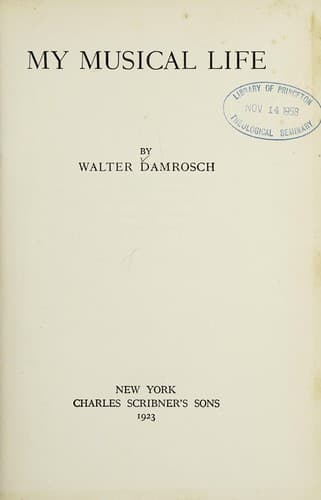
Conductors (Music) -- United States -- Biography; Damrosch, Walter, 1862-1950
On a frigid day last winter (January, 1922) travelling with my wife on
an untidy, dilapidated post-war train through Germany, on my way to
Stockholm to fill an engagement to conduct the orchestra there, we read
in an English magazine an article on Tennyson ending with a description
of the old graveyard in which lie the bodies of his two grandsons, both
killed in the war. “I did not know,” I said, looking out over the black
wintry flat German country, “that Tennyson lost _two_ grandsons in the
war!”
“But so did _my_ father,” my wife said proudly, and she spoke truly, for
another nephew, Emmons Blaine of Chicago was no less a war victim than
Walker. Unable to pass the physical tests required to enter the army he
agonized to find the nation’s greatest need behind the lines in which to
enlist. He chose shipbuilding and offered himself as a workman at Hogg
Island, near Philadelphia. Although never overstrong, he worked early
and late, and fell a victim of the terrible epidemic of the “flu,” dying
at Lansdown on October 9, 1918. Though Walker had already died in
France, we knew only at the time that he was wounded. Of his death we
learned four days later. Thus these two cousins, Emmons and Walker, are
forever enshrined together in our anguish, in our pride, and in our
love.
III
FOUNDING OF THE SYMPHONY AND ORATORIO
SOCIETIES OF NEW YORK
In 1873 Anton Rubinstein, greatest of Russian pianists, accompanied by
the violinist Wieniawski, came to America by invitation of Steinway and
Sons. He dined at our house and expressed wonder that my father had not
yet been able to achieve a position in New York commensurate with his
reputation and capacity. My father explained to him how difficult the
situation was and that the entire orchestral field was monopolized by
Theodore Thomas. He told Rubinstein that when he had first arrived in
New York he had met Thomas at the music store of Edward Schubert in
Union Square and that after the introduction Thomas had said to him:
“I hear, Doctor Damrosch, that you are a very fine musician, but I want
to tell you one thing: whoever crosses my path I crush.”
Thomas at that time really believed that America was not large enough to
contain more than one orchestra, but he lived long enough to see my
father surpass him at the head of a symphony orchestra, as founder of
the first great music festival in New York and, above all, of opera in
German at the Metropolitan.
In 1881 the first symphony orchestra on a permanent basis had been
founded in Boston by Major Higginson, and before Thomas’s death there
were half a dozen great subsidized orchestras actively operating in the
United States, a number which has since then increased to twelve.
Rubinstein said to my father: “Why don’t you begin by founding an
oratorio society, and that will lead to other things?”
Public-domain text, read in full here on John Shaqi.
Reviews
Reviews
No reviews yet
Be the first to share your thoughts on this work.
Join the Discussion
Join the discussion
Sign in to leave a comment or review.
Sign InorCreate an account