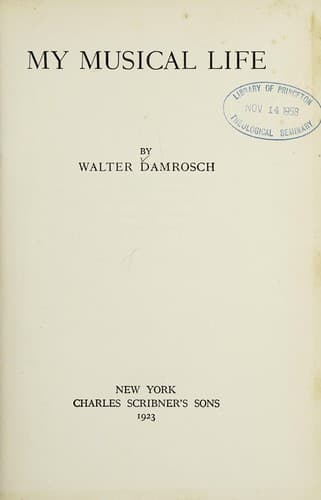
Conductors (Music) -- United States -- Biography; Damrosch, Walter, 1862-1950
My brother Frank had recognized the lack of good schooling for our army
bands and bandmasters many years before the war, and had very
patriotically placed the entire machinery of his Institute of Musical
Art at the disposal of the secretary of war. An arrangement had
accordingly been made by which a bandmaster’s school at Governor’s
Island, New York, was placed under my brother’s control, and for several
years before the war a small number of bandmasters were graduated from
it who ranked well on a par with those of other countries. But when we
entered the war and our army was organized on a scale of millions these
were but a drop in the bucket, and heroic measures were necessary to
bring some semblance of order into this musical chaos of hundreds of
uneducated bandmasters and thousands of still less educated bandsmen.
During these five weeks in Paris and Chaumont I worked very hard and,
while my life has been crowded with affairs of all kinds relating to my
profession, I cannot recall any time when the work was so constant day
and night or when I was more jubilantly happy in the doing of it. During
the forenoons Casadesus and I would examine the bandmasters, discover
what they could and could not do, give them, so to speak, “first aid to
the wounded” by pointing out their worst failings or their greatest
weaknesses. In the afternoons Lieutenant Weill and I would run around to
the various French government departments on the track of this or that
musician whom we wished to corral as professor for our school. At night
I would sit propped up in bed and work out the entire tuition plan of
the school, down to the minutest details.
My general recommendations to general headquarters, all of which were
subsequently carried out, included classes for the bandmasters’
instruction in the technic of conducting, in harmony, and in
orchestration. These classes were put in charge of M. Francis Casadesus
and M. André Caplet. The latter was later on succeeded by Lieutenant
Albert Stoessel, a highly talented bandmaster in our army, who has
returned to civilian life and has now become my successor as conductor
of the New York Oratorio Society.
Captain Ellacott, of the A. E. F., became the military head of the
school to which he gave most sympathetic assistance.
There were two professors each for oboe, bassoon, French horn, and
flügelhorn, all of whom were graduates and first prizes of the famous
Paris Conservatoire. I also recommended that the beautiful B-flat bugles
of the French army be adopted by us and that a French drum-major,
proficient on this instrument, be appointed as instructor to drill
successive classes of fifty for one month each, the graduates to become
first buglers of our regiments, in order that they might, in turn,
instruct other buglers in their respective drum and bugle corps.
Public-domain text, read in full here on John Shaqi.
Reviews
Reviews
No reviews yet
Be the first to share your thoughts on this work.
Elsewhere in the archive
Join the Discussion
Join the discussion
Sign in to leave a comment or review.
Sign InorCreate an account