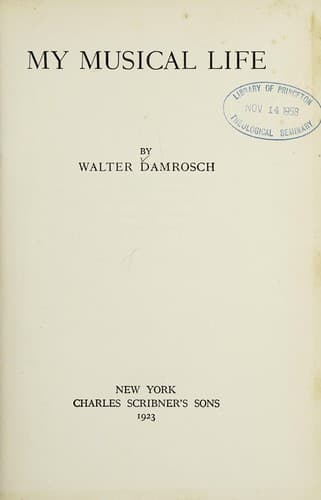
Conductors (Music) -- United States -- Biography; Damrosch, Walter, 1862-1950
At the examinations I also asked the bandmasters certain questions
regarding their position in their respective regiments, the attitude of
their colonel toward music, their general treatment, and the hours
allowed them for musical practice, and here I came on all kinds of
conditions. Some of the commanding officers had no sympathy with music
or with the bandsmen, and instead of making them practise their six
hours a day, they were put to work as kitchen police and on other
fatigue duties. I therefore urged that the commanding officers be
impressed with the fact that the primary object of the band is not to
fight, but to cheer the fighters, and the better their music, the
greater its beneficial effects upon the spirit of the soldiers, and that
therefore all bandsmen should be compelled to devote at least five or
six hours every day to the practice of their instruments and to
rehearsals, and that other duties should be made subsidiary to their
musical work and should not be of a character to unfit them for a proper
performance on their respective instruments.
I also discovered that there was a terrible wastage as regards musical
instruments and that in several instances, preparatory to going into
action, the instruments had been thrown away or simply left behind,
nevermore to be recovered, and that therefore it might be wise to
appoint a travelling inspector of musical instruments whose duties
should be to attend to the speedy replacement of missing parts, the
repairing of instruments, and the supplying of new music.
A really excellent headquarters band was formed at Chaumont, which
became a source of much gratification to the commander-in-chief and his
staff, accompanying him on many of his ceremonial visits and functions.
One of my most important recommendations for the school was that every
week at least one concert should be given by the professors and such of
the bandsmen as were really competent musicians. The programmes should
be made up only of the great master composers, in order that the
students—many of whom had come from isolated communities in our country
and had had but little opportunity to hear good music—should become
sensitive to the finer and more spiritual qualities of music as an art.
This was carried out in most remarkable fashion during the entire
existence of the school, and the programmes and their performance were
worthy of a place in any highly cultivated musical community.
Public-domain text, read in full here on John Shaqi.
Reviews
Reviews
No reviews yet
Be the first to share your thoughts on this work.
Elsewhere in the archive
Join the Discussion
Join the discussion
Sign in to leave a comment or review.
Sign InorCreate an account