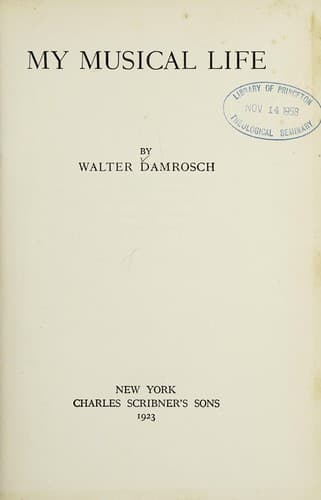
Conductors (Music) -- United States -- Biography; Damrosch, Walter, 1862-1950
To add to my worries, a railroad strike was announced for May 1, the day
on which the orchestra were to arrive at Le Havre, and not content with
that, the dock workers of Le Havre intended also to lay down their
“tools,” whatever they may be, and stop working on that date. When I
thought of the musical instruments and trunks of my orchestra in the
hold of the steamer _Rochambeau_, which was to arrive on or about May 1,
my heart stopped beating. However, I had been in too many close shaves
on my great Western orchestral tours to be altogether dismayed, for even
if the railroad stopped running there would always be motor-trucks and
airplanes. We had made arrangements with Thomas Cook and Sons to take
care of all transportation matters from the day the orchestra arrived in
France until their sailing for home from England, and they assured me
that, if necessary, they would have camions, such as were used during
the war, to carry my whole orchestra, together with their baggage and
musical instruments, from Le Havre to Paris.
Luckily the ship docked several hours before the dock workers’ strike
began, and double-basses, kettledrums, and innumerable music boxes were
safely landed from the hold of the ship. I had intended to go to Le
Havre to meet the orchestra, but the strike conditions were too
uncertain and I thought it better to remain in Paris and direct
operations from there.
The government was moving several trains, and the telegram that the
orchestra had started for Paris cheered me up considerably. I was at the
station at 3.30 that afternoon, to be met with the news that the train
was delayed and would be in at six. At six there was no sign of it, and,
as is usual at French stations, there was absolutely no one who had any
idea when it might arrive. I stayed there till eight o’clock—no train.
Finally there was a whistle. Every one dashed out. It was a
freight-train, but, like the dove from Noah’s Ark, I saw the “man from
Cook’s,” a little man, attired then and during the entire tour in a very
small derby hat and an exceedingly long double-breasted frock coat,
sitting on top of one of the cars. He was tired, dirty, but triumphant,
for all our musical instruments and music boxes were in these cars. He
had passed the orchestra half-way at Rouen, where they were held up by a
hot box. This sounded like home to me, as I had heard those magic words
only too often when our train, coming through Idaho or Arizona on our
way to or from California, would be held up for hours and we would
wonder whether we could “make” the concert that evening.
Public-domain text, read in full here on John Shaqi.
Reviews
Reviews
No reviews yet
Be the first to share your thoughts on this work.
Elsewhere in the archive
Join the Discussion
Join the discussion
Sign in to leave a comment or review.
Sign InorCreate an account