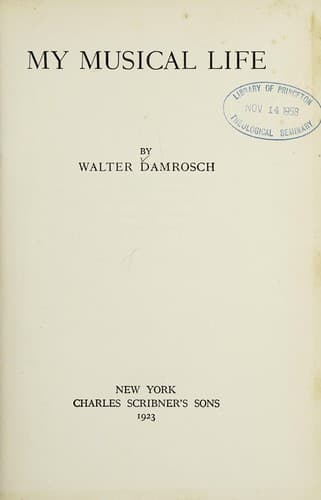
Conductors (Music) -- United States -- Biography; Damrosch, Walter, 1862-1950
From the very first chords of the “Eroica” Symphony, I noticed that the
slight improvements in our scenic surroundings, and above all the fact
that the house was filled with people, had acted like magic on the
acoustics. The tone of the orchestra had become full, clear, and
incisive. My spirits rose and I forgot everything except the orchestra
before me and Beethoven’s score. After each movement the applause was
deafening, and at the end of the symphony there was joyous shouting from
the galleries. We seemed to have played our way into their hearts, and
after the first part there was a steady stream of French musicians to my
dressing-room to congratulate me on our marvellous orchestra and its
ensemble, and to express their delight that we had come over on such a
friendly mission. Among them were: Vincent d’Indy, Gabriel Fauré, André
Messager, Gabriel Pierné, Theodore Dubois, Paul Vidal, Nadia Boulanger,
and many others.
As we turned into the French part of our programme the enthusiasm became
still greater, and at the conclusion of “Istar” some of my first violins
discovered the composer, d’Indy, in the audience and, pointing toward
him, stood up to applaud. In a minute not only the whole orchestra but
the audience were on their feet and with loud cries of “Auteur!”
“d’Indy!” the house was in an uproar until d’Indy, his face as red as a
beet, was compelled to rise and acknowledge this tribute.
The programme finished with the marvellous “Daphnis et Chloe,” by Ravel,
in which the luscious tone of the orchestra and its virtuosity
demonstrated themselves so successfully that not only did the concert
come to a tumultuous climax, but several of the French papers announced
afterward that this work had never had such a vivid and perfect
rendering before.
My interpretation of the Beethoven “Eroica” Symphony puzzled some of the
newspaper critics, as it did not conform to their French traditions.
These do not permit such slight occasional modifications of tempo as
modern conductors brought up in the German traditions of Beethoven
believe essential to a proper interpretation of this master. But I was
much pleased and honored to receive a complete approval of my
interpretation, not only verbally from several of my French colleagues,
but also from M. d’Indy in an article which he wrote on our concert and
in which he said:
Public-domain text, read in full here on John Shaqi.
Reviews
Reviews
No reviews yet
Be the first to share your thoughts on this work.
Elsewhere in the archive
Join the Discussion
Join the discussion
Sign in to leave a comment or review.
Sign InorCreate an account