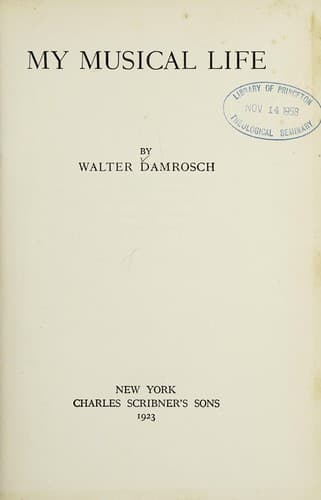
Conductors (Music) -- United States -- Biography; Damrosch, Walter, 1862-1950
The next day Mr. Phillips motored me to Amsterdam. There the members of
the local orchestra immediately poured into the willing ears of my men
dreadful stories of local jealousy of our coming, that several of the
newspapers had been told to criticise us severely, and that all the
adherents of the local orchestra had ostentatiously decided to absent
themselves from our concert. Very little of this proved to be true. The
huge hall in which we played, the Concertgebow, has a stage perched up
so high that the people in the parquet literally have to strain their
necks to see the performers, and the reverberation of sound is
excessive. The hall seats three thousand people, and there were not more
than fourteen hundred at our concert. However, they certainly made up in
enthusiasm what they lacked in numbers. All previous notions of the
phlegm of the Dutch people were completely dissipated. Not being a prima
donna, I did not keep count of the many times I was recalled after the
“Eroica” Symphony, but, as I had to march down and up a platform of
about fifty steps each time, the exercise in connection with it was
considerable. The newspapers next morning, in spite of all the dark
rumors, were enthusiastic in our praise and generous in their comparison
of our orchestra with their own splendid organization.
London marked the last lap of our musical race through Europe. We stayed
a week and gave five concerts, four at Queens’ Hall on June 14, 15, 16,
and 19, and one on June 20 at the huge Royal Albert Hall. The lucky star
which had accompanied us during the entire tour shone for us with
steadfast light during this last week. The orchestra never played better
and the newspapers heartily echoed the reception we received from the
public.
I had not conducted in London since a concert mentioned elsewhere in
these reminiscences, given at Princes’ Hall by Ovide Musin in 1888, when
I was but twenty-six years of age. Since then great changes have come
over the musical life of England. At that time music was to a great
extent in the hands of foreigners, and one has only to see the old
pictures by Du Maurier in _Punch_ to realize that the musician in
English drawing-rooms was generally a long-haired German or Italian.
Hans Richter was the great popular conductor in London and there were
many foreigners in the British orchestras.
Public-domain text, read in full here on John Shaqi.
Reviews
Reviews
No reviews yet
Be the first to share your thoughts on this work.
Elsewhere in the archive
Join the Discussion
Join the discussion
Sign in to leave a comment or review.
Sign InorCreate an account