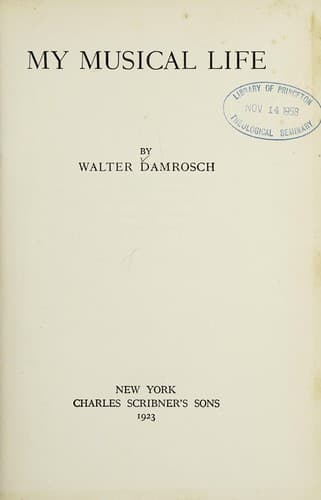
Conductors (Music) -- United States -- Biography; Damrosch, Walter, 1862-1950
Since then the Anglicization of music had been going on rapidly, thanks
principally to great music-schools such as the Royal College of Music,
under Sir Charles Villiers Stanford and Sir Hugh Allen, and the Royal
Academy of Music, under Sir Alexander MacKenzie. These schools educate
great numbers of orchestral musicians, and to-day the personnel of
British orchestras is composed almost entirely of native-born. Many of
us consider Sir Edward Elgar the greatest symphonic composer since
Brahms, and his education has been altogether British. A group of
English conductors, of whom Sir Henry Wood is the dean and Albert Coates
and Eugene Goosens among the most gifted, have made for themselves an
international reputation. England has now the material for a strong
national musical life. With such conductors as she possesses and her
splendid orchestral material, her orchestras would soon rival those of
America if her citizens would give them the same generous support which
our organizations receive, but in this respect the condition of London
is very much what it was in New York preceding and during the first half
of my career.
Her orchestras are to a great extent co-operative. The concerts are
projected and given by the members of the orchestra and they divide the
profits among themselves. These profits are exceedingly small and do not
really pay them for the time given to the rehearsals and concerts. The
London Symphony, for instance, gives only eight concerts during the
winter, and rarely has more than three rehearsals to a concert. In
consequence of this, while the players have developed a great facility
in reading at sight and making the most of the limited rehearsal time,
the results cannot be as finely worked out as is possible in the
generously endowed orchestras of America, which assemble their players
every morning for rehearsal and give more than one hundred symphonic
concerts during a winter.
We lay great stress on unanimity of bowing, for proper phrasing can only
be secured if the sixteen first violins, for instance, who have to play
a phrase in unison, play as one. To the educated ear there is a great
difference in the effect if one or two or more notes are played on the
same bow or if a phrase is begun with an up or a down bow. Generally
speaking, this unanimity in our playing impressed and delighted our
London audiences and critics, but one of the latter was evidently
annoyed by it as he began his analysis of our concert with the
head-line: “Orchestra Too Perfect to be Good.” His eye had evidently
been accustomed to the more “free and easy” bowing at some of their own
concerts, and he thought that a more emotionally inspired effect was
produced if the individual member of the orchestra is not restricted by
too much discipline. It must be acknowledged, however, that a good
conductor must guard himself from the temptation to make a god out of
technic, which should, after all, be merely a means to an end.
Public-domain text, read in full here on John Shaqi.
Reviews
Reviews
No reviews yet
Be the first to share your thoughts on this work.
Elsewhere in the archive
Join the Discussion
Join the discussion
Sign in to leave a comment or review.
Sign InorCreate an account