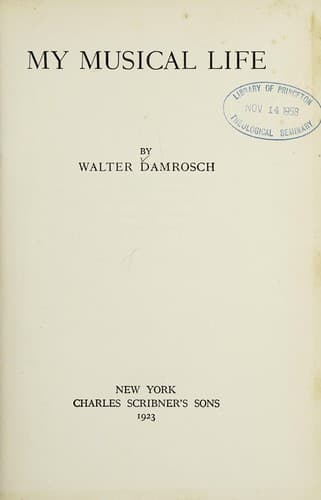
Conductors (Music) -- United States -- Biography; Damrosch, Walter, 1862-1950
Boston at that time occupied a unique position as the only city in
America which possessed a permanent orchestra, maintained by Major Henry
Lee Higginson, for the cultivation of symphonic music. A small group of
highly educated and socially prominent Bostonians, belonging to the
oldest New England families, made this orchestra almost the focus of
their social life. The weekly concerts were the great events, the
programmes eagerly discussed, and its conductor, Wilhelm Gericke, was
alternately cursed or blessed according to their attitude toward some
novelty which he had just produced.
Among this group I was made heartily welcome. The atmosphere was
intensely local, if not provincial, and as against the searching,
feverish life of a great metropolis like New York, with its many
conflicting interests and racial currents, the tranquillity and purely
American quality of Boston life, as it presented itself to me, was a
complete contrast. I am speaking of Boston of thirty-five years ago and
of conditions that have to a certain extent disappeared, for to-day even
the young descendants of the New Englanders of that era seem to find
their pleasures in different and more restless fashion.
In the group of which I have spoken, Mrs. Gardner was among the most
original and fascinating. She was certainly the leaven in the Boston
lump and sometimes shocked the more staid element by her innovations and
interest in more modern currents in art and literature than had hitherto
rippled its calm Emersonian surface. Boston was at that time perhaps the
best example of that typically American musical culture of which I have
spoken elsewhere, which instead of growing upward from the masses was
carefully introduced and nurtured by an aristocratic and cultivated
community through symphony concerts and lectures on music. Its original
impulse sprang perhaps more from the head than the heart, but it would
not be fair therefore to say that New Englanders approached music only
from the intellectual standpoint. I have seen very emotional outbursts
among Boston audiences, both at my Wagner recitals and years after when
I returned with the Damrosch Opera Company to give the Wagner
music-dramas. While it is possible that they felt heartily ashamed of
these enthusiasms afterward, and exclaimed, “Is this Boston?” the fact
remains that even a Bostonian is human, like other Americans, and needs
only to be encouraged to prove that he too has a heart which can beat
warmly and respond to the emotions kindled by art.
Their capacity for friendship in the finest sense of the word is
wonderful, and I achieved many of my dearest friends at that time. We
have all grown much older since then, with the exception of Mrs.
Gardner, on whom the years leave no imprint and whose enthusiasms for
life and art flame just as brightly to-day as then.
Public-domain text, read in full here on John Shaqi.
Reviews
Reviews
No reviews yet
Be the first to share your thoughts on this work.
Elsewhere in the archive
Join the Discussion
Join the discussion
Sign in to leave a comment or review.
Sign InorCreate an account