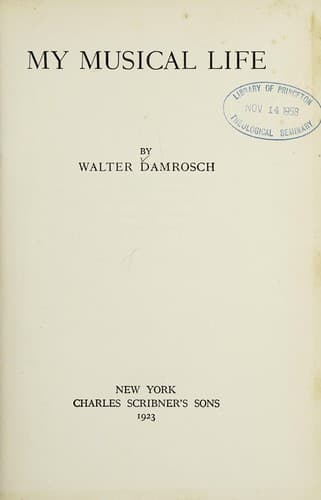
Conductors (Music) -- United States -- Biography; Damrosch, Walter, 1862-1950
I was certainly very young in those days, and remember, after one of my
lectures, which had gone off with great enthusiasm, walking along
Boylston Street toward my hotel, thinking in my young conceit that I was
evidently a good deal of a personage, when I saw that the street was
filled with crowds of people and the police were making a passage with
difficulty so as to allow an open carriage, drawn by two horses, to pass
through. In it sat a rather stout, smooth-shaven gentleman with a very
shiny high silk hat, and the people were cheering him like mad. “Who is
this?” I asked a bystander. He gave me a contemptuous look and stopped
cheering just long enough to say: “Don’t you know John L. Sullivan when
you see him?” I accepted the rebuke meekly and entered my hotel a much
more modest man than I had left it a few hours before. John L. Sullivan,
“Boston’s greatest citizen,” had just come home from a fight in London,
but I do not know to this day whether he had won or lost.
The Boston orchestra was at that time conducted by Wilhelm Gericke, who
had brought it to a remarkable state of proficiency. I found him to be a
very likable man, a thorough musician, and always gentle and friendly in
his attitude. I used to envy him because, while I had to maintain my
orchestra at that time by my own exertions, he had a great
philanthropist behind him. His orchestra was engaged by the year, played
under no other conductor, and assembled every morning at 9.30, like
clockwork, for rehearsal. Gericke brought the orchestra up to a high
standard of virtuosity. His sense of values was absolute, and under his
training and greatly assisted by Franz Kneisel, his concert master, the
strings soon acquired great unanimity and a ravishing quality of tone.
His readings were always musicianly, although I felt occasionally that
they were too reserved. He had a horror of the exaggeration of the brass
instruments, and perhaps erred on the other side in subduing them too
much; but when he returned, years after, for another five years in
Boston his readings had gained in freedom and elasticity, and the
balance of the different choirs seemed perfectly adjusted. Boston, and
indeed the country, owes him much. He was fortunate in his
opportunities, but he proved himself worthy of them.
Public-domain text, read in full here on John Shaqi.
Reviews
Reviews
No reviews yet
Be the first to share your thoughts on this work.
Elsewhere in the archive
Join the Discussion
Join the discussion
Sign in to leave a comment or review.
Sign InorCreate an account