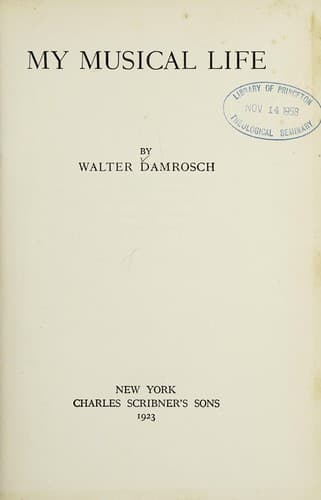
Conductors (Music) -- United States -- Biography; Damrosch, Walter, 1862-1950
Rightly or wrongly, Major Higginson had made it his rule to engage none
but German conductors for his orchestra. He had gained his first
enthusiasm for symphonic music as a young man in Vienna, and had got the
idea firmly in his mind that only Germany could give his orchestra the
leaders which it required. Among the long line of conductors who came
and went, not all, naturally, were of equal worth. A few were distinctly
second-raters, and I remember one whose blustering incompetence and
conceit finally so enraged Major Higginson that, as the gentleman would
not resign when requested because his contract still had another year to
run, Higginson sent him a check for the entire amount and dismissed him.
Curiously enough the impetus which the reputation of having been
conductor of the Boston Symphony Orchestra gave was so great that it
landed him in two other American orchestras, one of which he brought to
the very verge of ruin and the other he ruined altogether, so that the
city which had founded it and lavished hundreds of thousands upon it is
now without any symphony orchestra and seems to have lost the courage to
begin again.
But among the conductors of the Boston Orchestra two stand out as among
the best that Europe has sent over. These are Arthur Nikisch and Doctor
Karl Muck. The one died last winter, beloved and mourned by the musical
public of all Europe and of North and South America; the other was sent
from our country back to Germany after the war in deserved disgrace,
after having been interned as prisoner of war at Fort Oglethorpe.
When I first met Arthur Nikisch in 1887 he was conductor at the Leipsig
Opera House. I had gone there to attend an annual meeting and festival
of the Tonkünstler-Verein, an association of which Franz Liszt had
always been the president and which had originally been formed by a
small group of Liszt-Wagner-Berlioz adherents, of whom my father was
one. One of the features of the festival was a stage performance of
Berlioz’s “Benvenuto Cellini,” given in honor of Liszt. The work
fascinated me, and its performance under the young Nikisch delighted me
beyond words. In appearance he already had the same characteristics
which his enemies decried but which among his friends only aroused a
delighted chuckle when he appeared on the platform, and which quickly
changed to a hurricane of enthusiasm after he had demonstrated his
marvellous skill as an interpreter. I refer to the long black lock which
always hung low over his forehead and his still longer white cuffs which
more and more enveloped his little white hands as the performance
progressed.
Public-domain text, read in full here on John Shaqi.
Reviews
Reviews
No reviews yet
Be the first to share your thoughts on this work.
Elsewhere in the archive
Join the Discussion
Join the discussion
Sign in to leave a comment or review.
Sign InorCreate an account