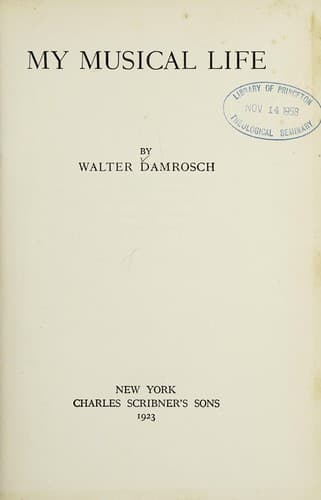
Conductors (Music) -- United States -- Biography; Damrosch, Walter, 1862-1950
The symphonies of Gustav Mahler have never received genuine recognition
here, although he was a very interesting apparition in the musical
field. He was a profound musician and one of the best conductors of
Europe, and it is possible that, in the latter capacity, he occupied
himself so intensely and constantly in analyzing and interpreting the
works of the great masters that he lost the power to develop himself as
composer on original lines. All his life he composed, but his moments of
real beauty are too rare, and the listener has to wade through pages of
dreary emptiness which no artificial connection with philosophic ideas
can fill with real importance. The feverish restlessness characteristic
of the man reflects itself in his music, which is fragmentary in
character and lacks continuity of thought and development. He could
write cleverly in the style of Haydn or Berlioz or Wagner, and without
forgetting Beethoven, but he was never able to write in the style of
Mahler.
Of all the greater composers of the last hundred years no one has been
killed oftener than Mendelssohn, yet he always seems to come back again
with a new renaissance. His music for “Athalie,” his “Reformation”
Symphony, his overtures to “Melusine” and “Ruy Blas” are dead as a
door-nail, but his Violin Concerto is still the most perfect example of
its kind, his “Midsummer Night’s Dream” the best incidental music ever
conceived for a Shakespearean play, his “Elijah” the most dramatic
oratorio ever written, and the Scotch and Italian Symphonies still
possess a delightful and eternal charm.
The works of Meyerbeer, on the contrary, have deservedly disappeared
even from our popular programmes. Those empty “Torchlight Dances” and
the vulgar ballet music from “Le Prophète”! I confess, though, that I
still have a sneaking fondness for the “Coronation March,” perhaps
because I had to conduct it so many times at the Metropolitan, when I
first began conducting the operas there. That the same man who penned
the glorious fourth act of the “Huguenots” could have been satisfied
with the empty drivel which preponderates during the rest of that opera,
is one of the eternal mysteries.
About thirty years ago Moritz Moszkowski was one of the most popular
composers of the day, especially for the piano, but modern ears have but
little use for his delicate, though evanescent, charm, and his
orchestral suites are but rarely heard to-day. He has lived in Paris for
many years, and during the war he suffered greatly. Advancing years and
a long illness had left him very weak, and it seemed almost as if the
musical world in which he had been so popular a figure had forgotten him
completely.
Public-domain text, read in full here on John Shaqi.
Reviews
Reviews
No reviews yet
Be the first to share your thoughts on this work.
Elsewhere in the archive
Join the Discussion
Join the discussion
Sign in to leave a comment or review.
Sign InorCreate an account