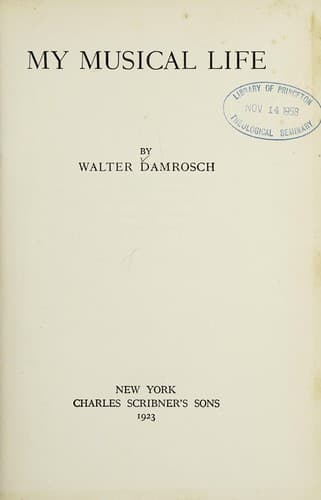
Conductors (Music) -- United States -- Biography; Damrosch, Walter, 1862-1950
But last winter, Ernest Schelling, one of our best American pianists,
and an old friend of Moszkowski’s, conceived the happy idea of giving a
testimonial concert in his honor, which should be thoroughly original in
character. He, together with his distinguished colleague, Harold Bauer,
accordingly enlisted the co-operation of twelve other celebrated
pianists who were in America during the winter. This list, a truly
remarkable one, included Elly Ney, Ignaz Friedman, Ossip Gabrilowitsch,
Rudolph Ganz, Leopold Godowsky, Percy Grainger, Ernest Hutcheson,
Alexander Lambert, Josef Lhevinne, Yolanda Mero, Germaine Schnitzer, and
Sigismond Stojowski.
Mr. Flagler offered the services of our orchestra, but as the stage was
to be completely filled with fourteen grand pianos, there was no room
for an orchestra, and I had to content myself with the possibility of
being taken on as a piano mover, as I longed to take part in the affair
in any capacity. The morning before the concert, however, I received a
hurried S. O. S. telephone call from Ernest Schelling. He said: “Please
come down to Steinway’s immediately and help us out. The fourteen
pianists are all here for rehearsal. We have arranged for several
compositions to be played by all of us, but alas, each one has his own
individual interpretation, and nothing seems to make us play together.
We need a conductor!”
When I arrived at the rehearsal hall the confusion was indeed
indescribable, and it took some time to bring order out of chaos. Here
were fourteen of the world’s greatest pianists, veritable prima donnas
of the piano, but several had never learned to adapt themselves to play
together for a common musical purpose, and when I rapped on my stand for
silence in order to begin the “Spanish Dances” of Moszkowski, at least
five or six continued their infernal improvising, playing of scales, and
pianistic fireworks. By using heroic measures I gradually produced a
semblance of order, and gave the signal for the beginning of the music.
The effect was extraordinary! Several of these pianists had never
followed a conductor’s beat, and after the first ten bars, two of them
rushed over to me, the one violently exclaiming that the tempo was too
fast, and the other insisting with equal vehemence that it was too slow.
Finally I obtained silence, and told my pianistic orchestra that they
were, undoubtedly, the fourteen greatest pianists in the world, and that
the interpretation of each one of them was undoubtedly equally the
greatest in the world, but as they represented fourteen different grades
and shades of interpretation, I intended to take the matter into my own
hands and they would just have to follow my beat whether they liked my
tempo or not. This was greeted with a roar of approval, and we now
settled down to the work of rehearsing as solemnly as if these prima
donnas of the ivories were orchestral musicians and routined members of
the New York Musical Union. Order followed anarchy, and the results
Public-domain text, read in full here on John Shaqi.
Reviews
Reviews
No reviews yet
Be the first to share your thoughts on this work.
Elsewhere in the archive
Join the Discussion
Join the discussion
Sign in to leave a comment or review.
Sign InorCreate an account