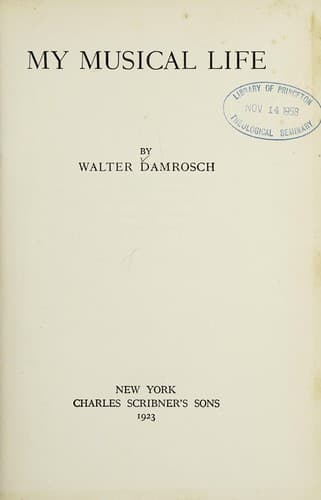
Conductors (Music) -- United States -- Biography; Damrosch, Walter, 1862-1950
The most popular modern symphonic composer in the ’70’s was Joachim
Raff. He was a young Swiss who, without a cent in his pocket, had walked
many miles from his little village in order to hear Liszt play at a
concert in Zurich. Liszt became interested in his undoubted talent, and
took him with him to Weimar as musical secretary. Raff, von Bülow, and
my father became great friends. But while every one expected that Raff
would continue as a true disciple of Liszt’s, and write in the
revolutionary style of his master, he gradually turned from him and
leaned more and more on classic models, although in several of his
symphonies he retained the Lisztian idea of programme music. As he grew
older his conservatism became more and more marked. He had great
facility and produced works in every known form of music, and his vanity
gradually made him believe that his string quartets were equal to
Mozart’s, his symphonies to Beethoven’s, and his oratorios to Handel’s
and Mendelssohn’s. His fecundity was astonishing, but his pen too fluent
for real musical depth. There was hardly a winter, however, that
Theodore Thomas or my father did not perform “Im Walde,” or the very
programmatic “Lenore” Symphony. This work, in which the last movement
follows closely and dramatically Burger’s famous ballad, had an enormous
popularity, and is occasionally performed by us to-day, but in general
the name of Raff means but little to modern concertgoers.
But perhaps the greatest tragedy of all was Anton Rubinstein, who
became, after Liszt, the world’s greatest piano virtuoso. The world
fêted him, spoiled him, and sated him with adulation. It all brought him
no satisfaction. He was consumed with the ambition to be considered a
great composer, and wrote incessantly, never criticising what he wrote.
His “Ocean” Symphony had a tremendous popularity in New York fifty years
ago, but to-day no one would listen to it. His “D Minor Concerto” has
been played, _ad nauseam_, by every pianist, but to-day it is threadbare
and frayed at the edges. Only the supreme skill of a Josef Hofmann can
make his “G Major Concerto” endurable and cloak its musical emptiness.
He wrote opera after opera in a feverish desire to eclipse Wagner, whom
he hated, and whose popularity he envied, and after “Parsifal” had been
proclaimed at Bayreuth as a “Sacred Festival Play,” he immediately
proceeded to write an opera on the life of Christ, which is so dull and
unconvincing that it has hardly had a performance anywhere.
His personal popularity was so great that Pollini, the astute manager of
the Hamburg Opera, occasionally used to put on one of his operas on
condition that he himself would come to Hamburg to conduct the opening
performance. His presence would insure a crowded house.
Public-domain text, read in full here on John Shaqi.
Reviews
Reviews
No reviews yet
Be the first to share your thoughts on this work.
Elsewhere in the archive
Join the Discussion
Join the discussion
Sign in to leave a comment or review.
Sign InorCreate an account