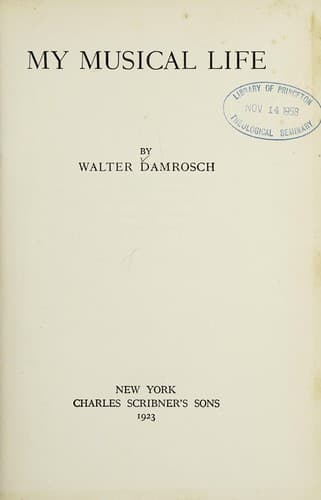
Conductors (Music) -- United States -- Biography; Damrosch, Walter, 1862-1950
At the last rehearsal of one of these operas Rubinstein was so well
pleased with the work of the orchestra that he turned to them and said:
“Gentlemen, if my opera is a success you must all come to my hotel after
the performance for a champagne supper.” Unfortunately, the opera was a
decided frost and the audience so undemonstrative that Rubinstein, in
absolute disgust, laid down the stick after the second act, and, bidding
the local conductor finish the opera, returned dejectedly to his hotel
and went to bed. At eleven o’clock there was a knock at his door. “Who
is it?” he shouted in great irritation. “It is I, Herr Rubinstein, the
double-bass player from the opera orchestra.” “What do you want?” “I
have come for the champagne supper.” “What nonsense!” raged Rubinstein.
“The opera was a ghastly failure.” “Well, Herr Rubinstein,” answered the
thirsty and undaunted double-bass player, “_I_ liked it!”
The disappearance of Schumann’s symphonies from concert programmes is
due to the fact that he was never at ease in writing for the orchestra.
His instrumentation is so thick and turgid as to be the despair of
conductors. So much of the music is exquisite, but it is like a precious
jewel imbedded in a foreign substance which conductors try in vain to
remove by changing the dynamics of this or that instrument, or by
leaving out an unnecessary doubling up of certain harmonies. All these
devices, however, can do but little. More heroic measures are necessary,
and I was much interested last summer when Sir Edward Elgar asked me
what I would think of his deliberately reorchestrating an entire
symphony of Schumann’s. I heartily applauded such an idea and begged him
to carry it out speedily as there is perhaps no one living to-day who
better understands the colors of the orchestra and knows how to produce
the most subtle shades in the intermingling of the different
instruments. In the meantime Frederick Stock, the noted conductor of the
Chicago Orchestra, has taken the bull by the horns and has written a new
orchestration of Schumann’s “Rhenish Symphony” which I hope to produce
this winter.
Are Sousa’s marches played nowadays? They should be. They are better
than the military marches of Europe of to-day, and while one cannot put
them into the category of higher musical efforts they are the only
American compositions of musical worth that have triumphantly blazed
their way all over the world.
Public-domain text, read in full here on John Shaqi.
Reviews
Reviews
No reviews yet
Be the first to share your thoughts on this work.
Elsewhere in the archive
Join the Discussion
Join the discussion
Sign in to leave a comment or review.
Sign InorCreate an account