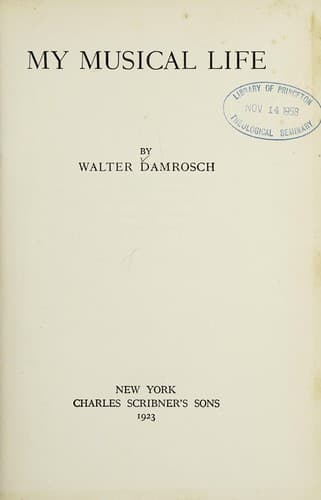
Conductors (Music) -- United States -- Biography; Damrosch, Walter, 1862-1950
Richard Strauss, who twenty-five years ago was the most interesting star
in the musical firmament, has lived long enough to have outlived a part
of his popularity. He never originated a musical form, but accepted the
symphonic poem of Liszt and the music-drama of Wagner as models. His
workmanship is infinitely greater than Liszt’s, his counterpoint
stupendous in its boldness, and in his treatment of the orchestra he
sometimes transcends even Wagner in the originality of his orchestral
combinations. But his compositions lack the ideality of either of these
masters, and because of this and in spite of his marvellous
paraphernalia, his works seem to carry within them the seeds of their
own decay.
The gods endowed this man at his birth perhaps more richly than any
other musician of our time, but something within him has made him
relinquish the greatest of their gifts and has turned him to less pure
ideals. In the “Sinfonia Domestica” the daily life of husband, wife, and
baby are characterized by an orchestra of one hundred and ten players
with such noisy fury and realistic prose as to give one an altogether
distorted insight into what is supposedly a page from the composer’s
diary. But the music descriptive of the composer who, after these
dreadful domestic squabbles, retires to his workroom, lights his lamp,
and begins to communicate with his muse, is so beautiful as to fill us
with a deep regret that one so winged for flight in the ether should be
so content to walk on the earth.
The instrumental devices, depicting _Don Quixote’s_ adventure with the
sheep and his fight with the windmill, which aroused such astonishment
and admiration when they were first heard, have already lost their
effect and are listened to to-day with hardly a smile. The final scene,
however, depicting the dying of _Don Quixote_, is so beautiful and
tragic in its expression as to bring tears to the listener. The
“Heldenleben” is to me a work of noisy bombastic emptiness from
beginning to end, and one might call it typical of certain German
currents of to-day. It would, however, be manifestly unfair to call it
typically German, as a race that has produced Bach, Mozart, Beethoven,
and Wagner will surely find other men to continue their glorious
traditions.
A composer’s fame is not affirmed by professional musicians but by the
general public whose judgment in the end is infallible. A great
masterwork that is not destroyed will always eventually be recognized as
such whether, like the “Venus de Milo,” it has lain hidden for centuries
beneath the earth or, like the “Matthew Passion” of Bach, equally hidden
in the dusty shelves of the Royal Library of Berlin, to be rediscovered
by Mendelssohn and pronounced the greatest religious choral work ever
written.
Public-domain text, read in full here on John Shaqi.
Reviews
Reviews
No reviews yet
Be the first to share your thoughts on this work.
Elsewhere in the archive
Join the Discussion
Join the discussion
Sign in to leave a comment or review.
Sign InorCreate an account