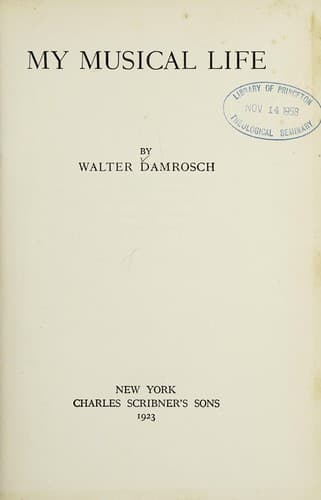
Conductors (Music) -- United States -- Biography; Damrosch, Walter, 1862-1950
Among the singers were Marianne Brandt, one of the greatest dramatic
mezzo-sopranos and contraltos of our times, and Anton Schott, a typical
German “heroic tenor,” with whom Bülow had had his famous altercation at
Hanover a few years before at a “Lohengrin” performance. Schott had sung
_Lohengrin’s_ “Farewell to the Swan” out of tune and this had so
irritated Bülow, who was conducting, that he turned on the unfortunate
tenor and said to him: “You are not a Knight of the Swan, but a Knight
of the Swine.” Schott, as an ex-officer in a Hanoverian regiment, deemed
his honor as an officer insulted, demanded an apology or a duel, and as
the irate von Bülow would grant him neither the one nor the other, Bülow
had to resign his post as director of the Royal Opera, while Schott
remained triumphant in his position.
For the youthful lyric soprano rôles my father had engaged Madame
Seidl-Kraus, the wife of Anton Seidl and possessor of a voice of great
purity and simple appeal. The coloratura rôles were sung by Madame
Schroeder-Hanfstangel, a truly great artist, with the real _bel canto_
of the Italian school, whom Gounod had admired so greatly that he
invited her to Paris to sing _Marguerite_ in “Faust” at the Grand Opera.
The other singers possessed both the virtues and the failings of the
German Opera School of that time. They were very amenable to ensemble
work, carrying out the dramatic side of their rôles with real ability,
forming an excellent ensemble, and tireless in rehearsing, but their
singing was sometimes faulty and not equal to the naturally beautiful
tone emission of the best Italian singers.
The stage-manager, Wilhelm Hock, was one of the best in Germany and his
management of the movements of great crowds on the stage, as for
instance in “Lohengrin” on the arrival of _Lohengrin_ and the _Swan_,
the building of the barricades in “Massaniello,” the Coronation Scene in
Meyerbeer’s “Le Prophète,” was a revelation to our public. The orchestra
was, of course, that of the New York Symphony Society, and my father
infused the entire ensemble with such an ideal of perfection that during
many of the performances, especially in “Lohengrin,” “Le Prophète,”
“Fidelio,” and “Walküre,” the public seethed with excitement and
enthusiasm. There had been an “improvised” performance of “Walküre” at
the Academy of Music under the German conductor Neuendorf a few years
before. The _Brunhilde_ had been sung by Madame Pappenheim, possessor of
a glorious voice, but the rest of the cast had been woefully deficient.
Insufficient rehearsals and ignorance of the music of Wagner on the part
of the conductor had also prevented this performance from making any
impression or giving any real idea of the beauties of the work.
Public-domain text, read in full here on John Shaqi.
Reviews
Reviews
No reviews yet
Be the first to share your thoughts on this work.
Join the Discussion
Join the discussion
Sign in to leave a comment or review.
Sign InorCreate an account