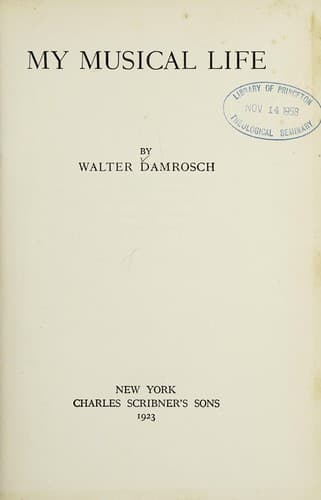
Conductors (Music) -- United States -- Biography; Damrosch, Walter, 1862-1950
I immediately determined to go to Germany and ask Bülow if, in view of
his old friendship with my father and my need of the help of some great
musician, he would be willing to let me study with him the
interpretation of the Beethoven Symphonies in especial, and such other
works as it would interest him to analyze for me.
Bülow was at that time considered the foremost conductor of Germany. He
had taken a little mediocre orchestra of fifty, belonging to the Grand
Duke of Meiningen, and through his supreme genius had galvanized it into
a marvellous instrument. Under his guidance this little orchestra had
created a sensation all over Germany and Austria and a special _tour de
force_ was their playing of certain symphonies entirely by heart without
any music before them.
When I arrived in Frankfort I found that Bülow was living at the Schwan
Hotel, and with much trepidation I told him what I wanted of him. He
seemed very much touched and claimed that it was the first time in his
experience that a musician who, as he put it, “was already prominent in
opera, symphony, and oratorio” thought he could learn anything from him.
In the warmest, I may say most affectionate terms, he promised me every
possible help and advised me to take rooms in the same hotel. This I
did, and I can truthfully say that the entire summer during which I was
with him in closest companionship, not only in his rooms and during the
lesson hours for the pianists, many of which I also attended, but on
long walks to the museums, the parks, and the suburbs of Frankfort, his
almost paternal kindliness, his wisdom, and his comments on things
artistic, literary, political, and personal were a revelation to me. So
many stories were current about his biting comments and brusque behavior
toward people who excited his enmity, that I was amazed to find him
throughout so companionable and so gentle in all his relations toward
me. He had a heart most tender and sensitive, but life had dealt this
idealist so many hard knocks that he incased his heart in a shell with
which to protect it from further onslaughts.
He went through all Beethoven’s nine symphonies with me, bar by bar,
phrase by phrase, and I still have the scores in which he made certain
notations of phrasing or illustrated changes in dynamics of certain
instruments in order to bring out the undoubted intentions of Beethoven
more clearly. He virtually analyzed the symphonies for me in the same
way as in his edition of the piano sonatas, and at the close of our
three months together he gave me a copy of his own score of the Ninth
Symphony with all his own annotations, many of which were based on the
analysis made by Wagner during his historic performance of that work at
the corner-stone laying of the Bayreuth Fest-Spielhaus.
Public-domain text, read in full here on John Shaqi.
Reviews
Reviews
No reviews yet
Be the first to share your thoughts on this work.
Join the Discussion
Join the discussion
Sign in to leave a comment or review.
Sign InorCreate an account