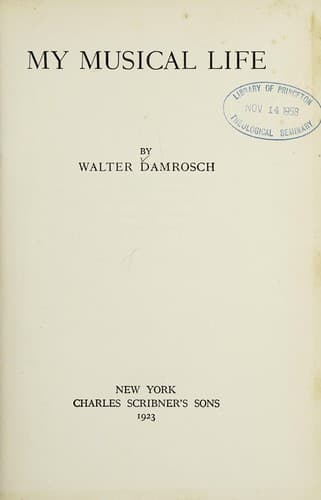
Conductors (Music) -- United States -- Biography; Damrosch, Walter, 1862-1950
_To Richard Pohl (distinguished writer on music and propagandist for
Wagner, Berlioz, and Liszt)_
Berlin, Sept., 1861.
. . . Damrosch had been engaged by Tausig for joint soirées in
Vienna and a long Russian concert tour, but the matter suddenly
came to naught, and although one cannot accuse T. of
irresponsibility, Damrosch is in such miserable fashion again
bound to that sterile Breslau. Poor, greatly talented, honest
chap—must fight his way through greatest _misère_. Is there
still no chance for him in Weimar? . . .
_To Joachim Raff (German composer of distinction)_
Berlin, Nov. 10, 1860.
. . . Your piano and violin sonata I am to play in Leipsig. Laub
and Singer are afraid of the Gewandhaus and are not keen about
it, so I don’t yet know whom I am to serve as accompanist.
Damrosch, with whom I played the composition six weeks ago,
conceives it according to my views quite exceptionally. The
adagio, for instance, he plays far more beautifully than Laub.
Very likely we shall turn to him. . . .
In 1870 the papers were filled with accounts of “the outrageous insult
of King William by the French ambassador, Benedetti,” and the hostile
attitude of Emperor Napoleon the Third. War was declared and of course
we boys immediately began to indulge in imitations of the military drill
of the soldiers of our city. The most exciting and welcome news to me at
the time was that my piano teacher had been drafted and I had high hopes
of not having to continue to undergo the dreary necessity of daily
finger exercises, but alas, my hopes were rudely dashed to the ground
when a bald-headed substitute appeared to continue the lessons.
Soon the trains were coming in, bringing the wounded, and the French
prisoners, among whom the dark-skinned Zouaves and Turks especially
excited our interest. We looked with envy at the older boys of our
school who, having studied French, used to go up to the French officers
and ask them whether there was anything they could do for them.
The war ended and my young piano teacher returned, resplendent in his
uniform with shining brass buttons, in which he paid his first
ceremonial visit to my father and mother. My mother, wishing to put him
at his ease, asked him to tell something of his experiences in the war,
but he was not very articulate. Yes, he had been at the beleaguering and
capitulation of Metz.
“How wonderful,” said my mother, “and what happened to you there?”
“Oh, well, they—they—shot at us.”
And that was all we could get out of him.
Public-domain text, read in full here on John Shaqi.
Reviews
Reviews
No reviews yet
Be the first to share your thoughts on this work.
Join the Discussion
Join the discussion
Sign in to leave a comment or review.
Sign InorCreate an account