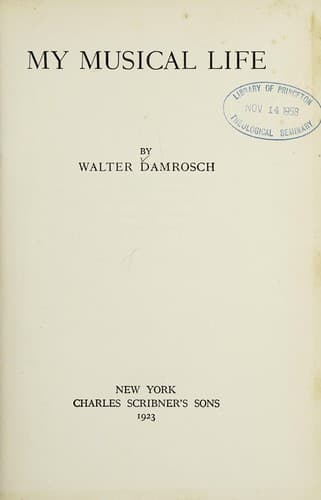
Conductors (Music) -- United States -- Biography; Damrosch, Walter, 1862-1950
I have told elsewhere how in those days I was compelled, because of my
youth, to confine myself at the Metropolitan to the conducting of such
operas as “Le Prophète,” “La Juive,” and “Trovatore.” Seidl, my older
colleague, completely monopolized the Wagner operas, which I was of
course particularly anxious to conduct. Against “Trovatore” I had at
that time a particularly strong and unreasonable aversion, although it
was partly justified in that we did not have a cast in our German Opera
Company that could do justice to its Italian atmosphere or its vocal
demands.
Whenever good luck would have it that the Saturday matinée was a Wagner
opera, I would ask for and obtain from Director Stanton the permission
to leave for Washington on Friday night, as this would enable me to
spend Saturday and Sunday with my fiancée. On one of these Fridays, just
after I had received my permission, my brother Frank came to me and
urged me to take the first train to Washington that I could catch, as he
had just heard that the tenor who was to sing in “Siegfried” on Saturday
afternoon was ill, and that in all probability the opera would be
changed to “Trovatore.” I quickly took the hint, and when the message
came that I was to conduct “Trovatore,” I was nowhere to be found and
Anton Seidl was compelled to conduct it. He was furious, as he had no
greater love for it than I, and my brother told me afterward that he
conducted the entire opera with a black scowl on his face, which was
bent low over the score and from which he never lifted his eyes once to
give a sign to singer or orchestra.
During the following winter, tragedies began to overwhelm the Blaine
family. Walker, the eldest son, a young man of great talent who had
inherited much of his father’s personal charm and who had become a great
help to Mr. Blaine in the State Department, died, to be followed shortly
after by the oldest daughter, Mrs. Coppinger.
These two tragedies, following so closely upon each other, were the
first break in that perfect family circle, and this affected Mr.
Blaine’s spirit and health to such an extent that I do not think his
vitality ever recovered from it.
I was married to Margaret Blaine on May 17, 1890. I should like to write
much more than a chapter about the thirty-two wonderful years of our
married life, but as my wife has sternly forbidden me to even mention
her name in these memoirs, this chapter must close with the best left
unsaid, though the most deeply felt.
X
THE DAMROSCH OPERA COMPANY, 1895-1899
Public-domain text, read in full here on John Shaqi.
Reviews
Reviews
No reviews yet
Be the first to share your thoughts on this work.
Elsewhere in the archive
Join the Discussion
Join the discussion
Sign in to leave a comment or review.
Sign InorCreate an account