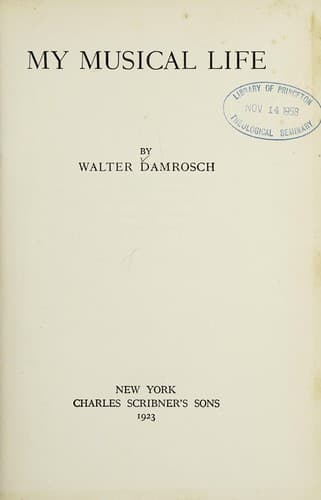
Conductors (Music) -- United States -- Biography; Damrosch, Walter, 1862-1950
With the return of Abbey, Schoeffel, and Grau in 1891, Wagner virtually
disappeared from the stage of the Metropolitan Opera House as their
entire energies were turned toward producing operas of the
French-Italian School. It was a natural reaction from the seven years of
opera in German and the pendulum swung far to the other side. A company
of truly great singers had been assembled by the new managers; the
audiences revelled in their _bel canto_, and as Abbey, Schoeffel, and
Grau assumed the entire financial responsibility of the enterprise, the
directors of the opera-house were also well satisfied. They had become
tired of the growing deficits of the German opera.
The head and controlling spirit of the firm was Henry Abbey, a
magnificent and honorable gambler in “stars” whom he paid so liberally
that, while he sometimes gained large profits, he many times lost more
heavily. The chances of profit were too small and generally it was too
much like the roulette tables at Monte Carlo, with the odds in favor of
the stars.
John Schoeffel was not much more than the hyphen between Abbey and Grau.
I never could see that he did anything except, perhaps, arrange for the
advertisements of the opera company when it visited Boston, where he
lived as lessee of the Tremont Theatre.
The actual direction of the opera season, the arranging of the
repertoire, the engagement of the artists, and the handling of them was
in the hands of Maurice Grau, who had developed into a first-class opera
manager. He claimed but little knowledge of things artistic, but he was
astute and had a real flair, up to a certain point, for giving the
public what it wanted. He was honorable in his dealings with the artists
and in a grudging way (which operatic artists often have) they liked
him, although they tortured him incessantly. He used to sit in his
office like a spider from morning until night, working out repertoires,
quarrelling with the singers or placating them, and altogether having no
interests in life beyond that—except, perhaps, the national game of
poker, in which he and a small group of cronies used to indulge—and a
great affection for his little daughter.
With the exception of “Lohengrin,” which had sporadic performances in
the Italian language, poor Wagner was virtually boycotted, and with my
great adoration for him I chafed under this condition more and more.
Public-domain text, read in full here on John Shaqi.
Reviews
Reviews
No reviews yet
Be the first to share your thoughts on this work.
Elsewhere in the archive
Join the Discussion
Join the discussion
Sign in to leave a comment or review.
Sign InorCreate an account