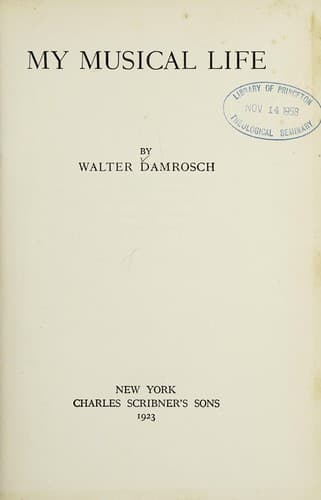
Conductors (Music) -- United States -- Biography; Damrosch, Walter, 1862-1950
I had chosen “Tristan” for the opening performance. It was in 1895. The
general rehearsal had gone well and an immense audience filled every
available space of the opera-house and greeted me warmly as I appeared
on the conductor’s stand. I was just about to begin the prelude when a
whisper reached me that the English horn player was not in his place. It
was old Joseph Eller, who had played in the Philharmonic under my father
many years before. He had, incredible to relate, forgotten his
instrument and, discovering this only on his arrival at the
Metropolitan, had rushed home but had not yet returned. Imagine my
agitation! Everything was ready, the lights turned down and the audience
expectant, and I finally did not dare to wait any longer. I assigned the
English horn part to the third French horn player and we began the
long-drawn sighs of the violoncellos of the introductory bars of the
prelude. To my great relief I saw Eller slip into his place a few
minutes later, and the performance moved well and dramatically toward a
triumphant close, in which Alvary, especially, distinguished himself by
his marvellous acting and impassioned singing in the scene preceding the
arrival of the ship bearing _Isolde_. Sucher invested _Isolde_ with a
gentle, womanly dignity, but vocally she was no longer quite in her
prime and did not, I think, equal Lilli Lehmann or Klafsky and Ternina,
whom I brought to America the following year.
To re-enter the Metropolitan on such a Wagnerian wave after German opera
had been so ignominiously snuffed out five years before, was a great
triumph and satisfaction for me, more especially because my father had
laid the foundation eleven years before.
I produced the other Wagnerian operas in quick succession, and as the
houses were sold out for every performance the profit was considerable.
Madame Marie Brema proved herself such a valuable member of the company,
both as _Ortrude_ and _Brangäne_, that I felt it would be wise to give
her the opportunity to sing _Brunhilde_ in “Walküre” as well. I,
therefore, quietly began to train her in that rôle. Unfortunately,
during a rehearsal which I had with her alone on the stage, Madame
Sucher happened to saunter in and, hearing the familiar music coming
from my piano, she suddenly beheld another woman singing _Brunhilde_.
She gave me one indignant but comprehensive glance and then majestically
sailed off the stage. A few hours later I received a letter in which she
announced to me that she wished to return to Germany on the next
steamer, as she had not been accustomed until then to have “her” rôles
sung by another as long as she was in the company.
This was the first letter of the kind that I had received during my
short career as opera impresario, but it was but the prototype of many
similar ones that followed each other like snowflakes in a storm during
my various opera seasons.
Public-domain text, read in full here on John Shaqi.
Reviews
Reviews
No reviews yet
Be the first to share your thoughts on this work.
Elsewhere in the archive
Join the Discussion
Join the discussion
Sign in to leave a comment or review.
Sign InorCreate an account