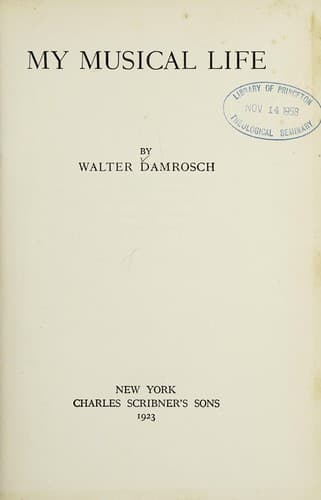
Conductors (Music) -- United States -- Biography; Damrosch, Walter, 1862-1950
I, of course, immediately sent Madame Sucher a large bouquet of roses
and wrote to her that, quite apart from contractual obligations, I could
not understand how she would want to leave America after she had “sung
herself so gloriously into the hearts of my countrymen.” I do not know
whether my letter or the roses had any effect, or whether wiser counsels
prevailed, but she stayed with me and continued her work with great good
nature and even endured the hated sight of having Marie Brema sing
_Brunhilde_ at several of the subsequent performances.
In Kansas City we ended our stay with a matinée performance of
“Siegfried,” Madame Sucher as _Brunhilde_ and Max Alvary, the handsome,
as _Siegfried_. My readers will remember the great scene in which
_Brunhilde_ is awakened from her slumber of years by the kiss of
_Siegfried_, who bends over her in that delightful but difficult
position for a long time until a certain bar in the music denotes that
the kiss is ended. The house was crowded and the greater part of the
audience were women. Suddenly, while I was conducting the exquisite
music accompanying the extended kiss, some one in the gallery inclined
to facetiousness imitated very distinctly the smacking sound of kissing,
and, to my horror, little ripples of feminine laughter rose and fell,
awoke and died, to be renewed again. Alvary was wonderful. He raised his
handsome head, gazed with calm eyes at the audience until a death-like
silence reigned and then, with equal calm, returned to his previous
occupation. It was certainly a triumph of man over woman, or rather
women, and at the end of the act they greeted this young god with
special and adoring enthusiasm.
The entire profits of my first venture as owner and director of an opera
company for thirteen weeks amounted to about fifty-three thousand
dollars. (Alas! I did not retain this quickly gained fortune a long
time.)
I had again planted the flag of Wagner firmly in American ground and
naturally did not wish to see it pulled down again. I therefore called
on Abbey and Grau and—as I had no desire for managerial honors, the
artistic side of it only interesting me—begged them to add a German
department to their really splendid galaxy of French and Italian artists
and to let me take care of it for them. But at that time they did not
seem ready to alter their traditional operatic scheme, and my suggestion
did not meet with a favorable response. I then decided that I would go
on myself. My first season had taught me a great deal. I had acquired a
considerable stock of scenery, costumes, and properties, and I knew
where I could still further improve the artistic personnel of my
company. I thought that by arranging for a longer season of five months
I should be able to give my singers and orchestra better contracts
financially and also introduce the Wagner operas over a greater
territory.
Public-domain text, read in full here on John Shaqi.
Reviews
Reviews
No reviews yet
Be the first to share your thoughts on this work.
Elsewhere in the archive
Join the Discussion
Join the discussion
Sign in to leave a comment or review.
Sign InorCreate an account