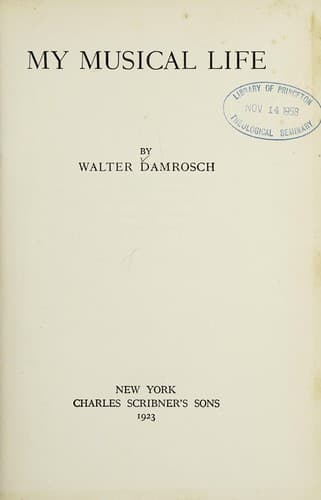
Conductors (Music) -- United States -- Biography; Damrosch, Walter, 1862-1950
In the spring of 1898 Madame Nellie Melba, the golden-voiced, told me
that she would like to join my company for the following winter, and
suggested that her manager, Mr. Charles Ellis, well known as the manager
of the Boston Symphony Orchestra, form a partnership with me, the
company to be called The Damrosch-Ellis Opera Company, half of the
repertoire to be devoted, as before, to the Wagner operas and the other
half to the performance of French-Italian operas with herself as the
principal singer. We were to pay her fifteen hundred dollars a night,
ten times a month, guaranteed. The suggestion seemed to me reasonable
and advantageous, and arrangements were made accordingly. This
combination aroused great indignation on the part of Mr. George Haven,
the president of the Metropolitan Opera House. Mme. Melba had been one
of the principal singers there for several years and he felt that it was
an act of ingratitude on her part to leave the Metropolitan, and on mine
to take her into my company, as I had myself been associated with the
Metropolitan during so many years while he was president. I did not
think that his anger was justified, as a great deal of water had flowed
down-stream since those days; and, as Melba, for reasons of her own, had
definitely decided to sever all connections with the Metropolitan, I
could not see why I should not make her a member of my company. But he
could not, or would not, see my side of the controversy, and vowed that
as long as he was president of the Metropolitan I should never set foot
in it again in a professional capacity. This vow, however, was
subsequently not adhered to, as I not only gave performances there later
with my own company, but during the seasons of 1900-01 and 1901-02
officiated again as conductor of the Wagner operas for Maurice Grau, who
had then become the sole director and lessee of the Metropolitan.
The combination of Wagnerian operas with the operas of the
French-Italian school, of which Melba was the glorious star, proved
successful from a popular and financial standpoint, and the season
showed a handsome profit for Ellis and myself, although a great part of
this was dissipated by a spring tour in which Melba, supported by a
small company of singers, chorus, and orchestra, toured the Western
cities. This tour was managed by my partner, Ellis, and I did not
accompany them, as my services as conductor were not needed for the
French operas. I had by that time definitely decided to give up all
further connection with opera as manager and devote my future life
absolutely to purely musical work as a symphonic conductor and, as I
hoped, also as composer. The harassing occupation of “managing” singers
proved increasingly distasteful to me, and I felt that I was too good a
musician and artist to waste my time with such things in which the only
advantage could be a possible pecuniary gain.
Public-domain text, read in full here on John Shaqi.
Reviews
Reviews
No reviews yet
Be the first to share your thoughts on this work.
Elsewhere in the archive
Join the Discussion
Join the discussion
Sign in to leave a comment or review.
Sign InorCreate an account