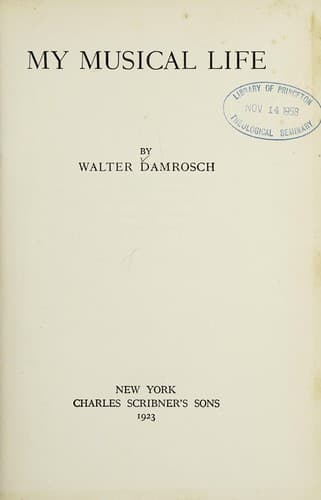
Conductors (Music) -- United States -- Biography; Damrosch, Walter, 1862-1950
I found that many singers were like children with no clear conception of
right or wrong. Their constant life in close proximity to each other at
rehearsals and performances often begets an exaggerated conception of
themselves and their importance to the world. They think that as their
contact with the public is only over the footlights, where they receive
enthusiastic acclaim for their artistic representations, the public
literally exists only for the purpose of hearing them sing, and they
willingly ignore the fact that the public may have other interests, such
as family, finance, politics, or religion to claim its attention. As it
is important for a manager not only to maintain a balance in his ledger
but to seek the best results that a disciplined ensemble may attain, he
cannot always be in harmony with all the individual desires and demands
of his artists. He must often cast his opera in opposition to their
personal pride, and I have letters to-day from several of the greatest
artists of my company insisting that they must leave or break their
contracts because I had wounded their deepest sensibilities in putting
so and so in the rôle which they claimed for their very own.
I found that some of them even indulged in occasional efforts at petty
blackmailing. One of my tenors, who shall be nameless, had a clause in
his contract that he should not be called upon to sing _Tristan_ the day
after a very long railway journey. We had played in Cleveland, giving a
“Lohengrin” performance in which, however, the other tenor had appeared,
and took a night train in comfortable sleeping-cars in one of which my
tenor occupied a drawing-room to Pittsburgh, which is, as my reader is
aware, a distance of only 150 miles or so. As we left Cleveland my
friend the tenor appeared in my drawing-room, and, calling attention to
the clause in his contract relating to _Tristan_ and a “long” railway
trip, insisted that he could not sing _Tristan_ the following day in
Pittsburgh without endangering his voice. But if I would pay him five
hundred dollars extra he would take the great risk of injuring his voice
and would agree to sing. Naturally I was furious and told him politely
but firmly what I thought of him, and then sent for my other tenor and
told him that his rival was trying to blackmail me and I suggested to
him that if he would sing _Tristan_ for me in spite of his having sung
_Lohengrin_ the night before, I would consider it as a performance
outside of his guarantee. Needless to say he jumped at the opportunity
of gaining an extra six hundred dollars and at the same time “putting
one over” on his hated rival. I then went to bed and slept soundly on a
pillow made downy by a deed well done.
Next morning I received word from tenor No. 1 that he had changed his
mind, was feeling very well, and would sing, but I very haughtily told
him that it was too late and that I had already made other arrangements.
Public-domain text, read in full here on John Shaqi.
Reviews
Reviews
No reviews yet
Be the first to share your thoughts on this work.
Elsewhere in the archive
Join the Discussion
Join the discussion
Sign in to leave a comment or review.
Sign InorCreate an account