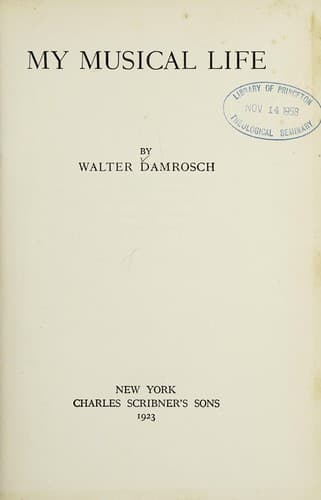
Conductors (Music) -- United States -- Biography; Damrosch, Walter, 1862-1950
Among other reasons that impelled me finally to give up the opera was
the realization how comparatively seldom absolute artistic perfection
can be obtained at a stage performance. There are so many people
concerned in it that it is almost impossible always to obtain a cast
which is thoroughly satisfactory, and one “second rater” can spoil an
ensemble. Still another problem was the question of stage illusion. I
gave this a great deal of attention and study, and spent a great deal of
money on scenery and lighting. I examined the best inventions in this
direction in the opera-houses of Germany and imported many of them. I
was the first to bring over the very clever swimming-machines used in
Dresden by the Rhine Maidens in “Rhinegold.” But Wagner’s demands on the
stage are so extraordinary that a real illusion is not often possible.
His music excites the imagination and is often all sufficient. One can
see the glorious flames crackling and burning around the sleeping
_Brunhilde_ when one hears an orchestra of a hundred playing the music
of the “Fire Charm,” but how seldom does a stage performance enhance
this illusion! The _Brunhilde_ may be too big and too fat, or the light
of the flames may too clearly show that the scenery is but painted
canvas and pasteboard after all, and our sophisticated eyes know only
too well how the plumber’s steam-pipes convey the steam that is intended
to simulate the smoke of the flames from the boiler in the cellar. It
sometimes seemed to me, after striving in vain to carry out Wagner’s
ideal of a union of all the arts in order to produce a new and perfect
art form (the “music-drama”), as if this great genius had really
committed a gigantic mistake, and as if the very artistic illusion and
semblance of verity was destroyed by the scenic paraphernalia.
Of course there were performances over which a happy star seemed to
shine and which now and then gave us complete satisfaction and
happiness. But the static quality of scenery became to me more and more
a hindrance to an imagination ready to soar on the wings of the music.
I carried on my opera company for another year in conjunction with Mr.
Charles Ellis, and then definitely resolved to cease all managerial
activities and to confine myself absolutely to purely musical work. It
took me some time to arrive at this decision, as opera work has also a
very fascinating side, and I had made real friends with many of my
singers.
I had found Ellis to be a delightful partner. He had had years of
experience as manager of the Boston Symphony Orchestra, and his equable
temperament and fairmindedness had made him many friends. I sold to him
my share in all our scenery, costumes, and properties as he wished to
continue operatic work with Madame Melba as his principal star, and I
agreed to conduct a limited number of Wagner performances for him in
Philadelphia during the following season.
Public-domain text, read in full here on John Shaqi.
Reviews
Reviews
No reviews yet
Be the first to share your thoughts on this work.
Elsewhere in the archive
Join the Discussion
Join the discussion
Sign in to leave a comment or review.
Sign InorCreate an account