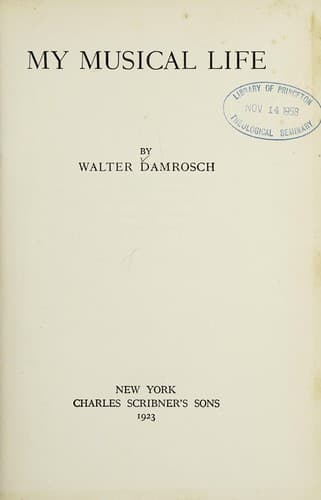
Conductors (Music) -- United States -- Biography; Damrosch, Walter, 1862-1950
After the four hectic years I had spent with the Damrosch Opera Company
I was glad of such an opportunity to take stock of the past and cogitate
on the future.
My wife and I rented the old Butler place in Westchester County, near
Hartsdale—a lovely old mansion surrounded by dark pine forests and with
the little Bronx River trickling through—and there we spent most of the
winter until May. I wrote a violin sonata there and enjoyed the
tranquillity of a life freed from operatic worries and excitements.
In 1900 I was once more tempted into the field of opera, but this time
it carried with it no managerial or financial responsibility.
Maurice Grau was at that time the lessee of the Metropolitan Opera
House. Abbey had died a few years before and the directors, who had
gradually realized that it was Grau who had been the real “man behind
the gun,” gave him and a small group of financial backers the lease of
the Metropolitan Opera House. Grau invited me to return to the
Metropolitan as conductor for the Wagner operas. He had at that time a
strong group of Wagnerian singers. At the head was the inimitable Jean
de Reszke, together with his brother Edouard. Grau had also taken over
from my company Madame Ternina, David Bispham, and Madame Gadski. The
latter had been a member of the Damrosch Opera Company for the entire
four years of its existence. She was only twenty-three when I first
engaged her, possessor of a lovely voice, and an indefatigable worker.
There were weeks on our Western tours when she would appear on five
successive days as _Elsa_, _Elizabeth_, _Sieglinde_, and _Eva_. She was
a hard student and her voice developed more and more. During her last
year with me she added the “Walküre” and “Siegfried” _Brunhildes_ to her
repertoire, studying them with me, partly on the trains while
travelling, partly in the hotels and theatres of the various cities we
visited. When she went into the Grau Company, she added the
“Götterdämmerung” _Brunhilde_ and _Isolde_, thereby completing the
entire circle of Wagner soprano parts, except _Kundry_.
Jean de Reszke, like Lilli Lehmann, turned to the Wagnerian rôles in the
high noon of his operatic career. He had made his fame in the
French-Italian operas, but Wagner attracted him irresistibly.
Public-domain text, read in full here on John Shaqi.
Reviews
Reviews
No reviews yet
Be the first to share your thoughts on this work.
Elsewhere in the archive
Join the Discussion
Join the discussion
Sign in to leave a comment or review.
Sign InorCreate an account