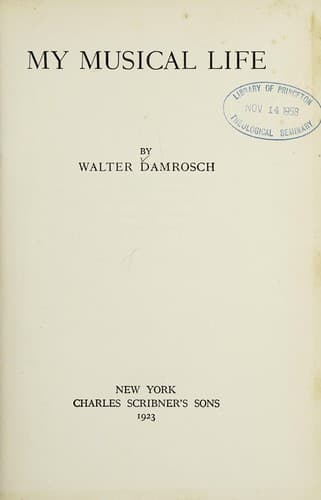
Conductors (Music) -- United States -- Biography; Damrosch, Walter, 1862-1950
I remember that during one of the seasons of the Damrosch Opera Company
we were playing in Boston at the Boston Theatre while the Abbey and Grau
Company were performing in the huge Mechanic’s Hall. Jean and Edouard de
Reszke attended one of my “Siegfried” performances with Max Alvary in
the title-rôle. They applauded their colleague vociferously, and after
the performance Jean lamented to me that he was compelled to sing
nothing but _Fausts_ and _Romeos_ and _Werthers_, while it was the
ambition of his life to sing Wagner. The memory of his extraordinary
impersonations of these rôles later on is too vivid to need comment from
me. Illness kept him away from America one year, and when he returned I
was again at the Metropolitan as conductor of the Wagner operas. It was
a joy to work with this man. Great artist, courteous gentleman, and
generous colleague, and (what is most valuable to a conductor)
indefatigable at rehearsals. His return was like the triumphant entry of
a victorious monarch. He was a marvellous mimic, and used to give us
delicious imitations of the various artists of the company coming into
his dressing-room to offer their congratulations after his first
reappearance.
De Reszke would first depict the French tenor colleague who in polite,
reserved, and even patronizing accents would say:
“Vraiment, mon cher, vous-avez chanté très bien ce soir, très bien, je
vous assure!”
Then would come the German barytone in a double-breasted frock coat and
punctiliously polite manner, saying:
“Erlauben Sie mir, Herr de Reszke, Ihnen meine grosse Hochachtung aus zu
drücken für den wirklich ausgezeichneten Genuss den Sie uns heute Abend
bereitet haben.”
He was followed by the Italian barytone, who would rush in impulsively
and, kissing Jean on both cheeks, would exclaim:
“Caro mio, carissimo!” followed by a flood of Italian words.
Then came the real climax of the scene. Enter the electrician who,
thrusting a “horny hand of toil” into that of de Reszke, would exclaim
in real “Yankee” accents:
“Jean, you done fine!”
Edouard de Reszke, the huge bass brother with the heart of a child and
an imperturbable good nature, was an equally good mimic. But his
wonderful stories and impersonations were of a decidedly Rabelaisian
character and will not bear repetition here.
With these two well-corseted but un-Corsican brothers, Madame Ternina or
Madame Nordica, Madame Schumann-Heink, and David Bispham we gave
performances of “Tristan” which came as near perfection as I ever hope
to witness.
Public-domain text, read in full here on John Shaqi.
Reviews
Reviews
No reviews yet
Be the first to share your thoughts on this work.
Elsewhere in the archive
Join the Discussion
Join the discussion
Sign in to leave a comment or review.
Sign InorCreate an account