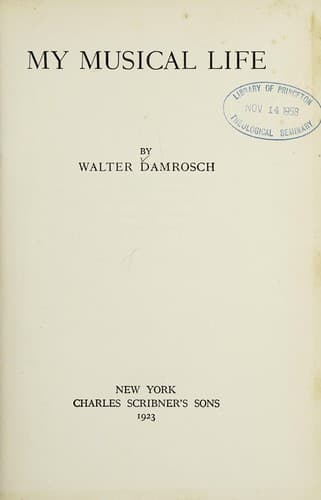
Conductors (Music) -- United States -- Biography; Damrosch, Walter, 1862-1950
In the spring of 1891 Carnegie Hall, which had been built by Andrew
Carnegie as a home for the higher musical activities of New York, was
inaugurated with a music festival in which the New York Symphony and
Oratorio Societies took part. In order to give this festival a special
significance, I invited Peter Iljitsch Tschaikowsky, the great Russian
composer, to come to America and to conduct some of his own works. In
all my many years of experience I have never met a great composer so
gentle, so modest—almost diffident—as he. We all loved him from the
first moment—my wife and I, the chorus, the orchestra, the employees of
the hotel where he lived, and of course the public. He was not a
conductor by profession and in consequence the technic of it, the
rehearsals and concerts, fatigued him excessively; but he knew what he
wanted and the atmosphere which emanated from him was so sympathetic and
love-compelling that all executants strove with double eagerness to
divine his intentions and to carry them out. The performance which he
conducted of his Third Suite, for instance, was admirable, although it
is in parts very difficult; and as he was virtually the first of great
living composers to visit America, the public received him with
jubilance.
He came often to our house, and, I think, liked to come. He was always
gentle in his intercourse with others, but a feeling of sadness seemed
never to leave him, although his reception in America was more than
enthusiastic and the visit so successful in every way that he made plans
to come back the following year. Yet he was often swept by
uncontrollable waves of melancholia and despondency.
The following year in May I went to England with my wife, and received
an invitation from Charles Villiers Stanford, then professor of music at
Cambridge, to visit the old university during the interesting
commencement exercises at which honorary degrees of Doctor of Music were
to be given to five composers of five different countries—Saint-Saëns
of France, Boito of Italy, Grieg of Norway, Bruch of Germany, and
Tschaikowsky of Russia.
The proceedings proved highly interesting and enjoyable. As each
recipient of the honor stepped forward in his doctor’s robe, the orator
addressed him in a discourse of orotund Latin phrases, praising his many
virtues and accomplishments, and these phrases were constantly
interrupted by the clatter of facetious remarks and requests from the
undergraduates in the balcony, all this according to old-established
custom. Sometimes the uproar became so great that the presiding officer
had to arise and demand “Silentium.”
Public-domain text, read in full here on John Shaqi.
Reviews
Reviews
No reviews yet
Be the first to share your thoughts on this work.
Elsewhere in the archive
Join the Discussion
Join the discussion
Sign in to leave a comment or review.
Sign InorCreate an account