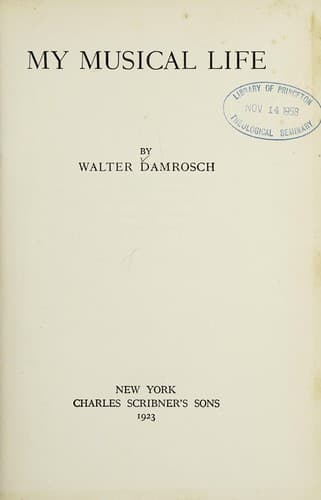
Conductors (Music) -- United States -- Biography; Damrosch, Walter, 1862-1950
Among the other recipients of degrees on that occasion was Field-Marshal
Lord Roberts, Baron of Kandahar, who, in his scarlet uniform beneath his
doctor’s robe, received of course the most uproarious welcome. At that
time no one dreamed that twenty-three years later he would go around
England uttering solemn warning against the inevitability of war with
Germany and bidding England gird on her sword and prepare, only to be
laughed at as an alarmist and publicly reprimanded by politicians for
seeking to arouse such feeling against a “friendly power.”
In the evening a great banquet was given in the refectory of the
college, and by good luck I was placed next to Tschaikowsky. He told me
during the dinner that he had just finished a new symphony which was
different in form from any he had ever written. I asked him in what the
difference consisted and he answered: “The last movement is an adagio
and the whole work has a programme.”
“Do tell me the programme,” I demanded eagerly.
“No,” he said, “that I shall never tell. But I shall send you the first
orchestral score and parts as soon as Jurgenson, my publisher, has them
ready.”
We parted with the expectation of meeting again in America during the
following winter, but, alas, in October came the cable announcing his
death from cholera, and a few days later arrived a package from Moscow
containing the score and parts of his Symphony No. 6, the “Pathétique.”
It was like a message from the dead. I immediately put the work into
rehearsal and gave it its first performance in America on the following
Sunday. Its success was immediate and profound. We gave it many
repetitions that winter and I have played it since in concerts all over
the United States. Other orchestras have cultivated it with equal
assiduity, and in fact for me the time came several years ago when I
cried a halt and let the work lie fallow, as it had evidently been
overplayed and its high-strung rhythms had excited the nerves of
executants and audiences so often that they were in danger of being
overstrained.
Public-domain text, read in full here on John Shaqi.
Reviews
Reviews
No reviews yet
Be the first to share your thoughts on this work.
Elsewhere in the archive
Join the Discussion
Join the discussion
Sign in to leave a comment or review.
Sign InorCreate an account