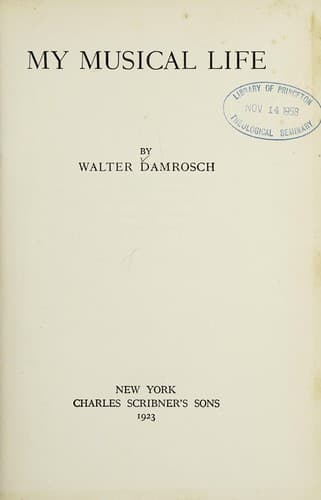
Conductors (Music) -- United States -- Biography; Damrosch, Walter, 1862-1950
“Zat is not all ze difference!” Paderewski immediately exclaimed in his
gentle Polish accents. “I am a poor Pole playing solo, but Johnny is a
dear soul playing polo.”
He is highly gifted as a composer, and besides a very interesting and
spiritual symphony I remember with keen pleasure his opera “Manru,”
which Maurice Grau brought out at the Metropolitan Opera House in 1902
and which I conducted. I cannot remember ever having worked harder
toward achieving a successful première. The orchestral parts, which had
been copied in Germany in a great hurry, arrived so full of mistakes
that the first rehearsals were an agony of constant stopping and
correcting, and these corrections went on during the entire time of
preparation, and I believe that I still found two inaccuracies at the
rehearsal just preceding the general rehearsal. Again and again I took
some of the worst parts home and worked late into the night going
through them meticulously myself, and comparing them with the orchestral
score in an endeavor to bring order out of chaos. The opera received a
warm welcome, but the libretto was lacking somewhat in dramatic
interest; and the music, with all its genuine charm and warmth, was not
able to successfully combat this lack.
I think that if Paderewski had been willing to sacrifice his marvellous
career as a piano virtuoso (and that would have been a great sacrifice)
he would have become one of the greatest composers of our time. It does
not seem easy to unite the two careers, as they are essentially at war
with each other. Liszt, the only man with whom I can compare Paderewski,
recognized this fact, and at forty years of age resolutely turned his
back on virtuosodom, with its life in the public glare, its excitements,
crowds, and emoluments, in order to devote himself to composition. He
settled in the little town of Weimar, living a life of poverty, and
never again touched the piano for personal gain. Only now and then he
would play in public in order to gather funds for the Beethoven monument
in Bonn or for some great charity. And yet it is universally conceded
that even he stopped too late and that, great as is the sum total of his
contributions to creative art, he would have been still greater and able
to express himself more genuinely if he had never been “the greatest
pianist of his generation.”
Public-domain text, read in full here on John Shaqi.
Reviews
Reviews
No reviews yet
Be the first to share your thoughts on this work.
Elsewhere in the archive
Join the Discussion
Join the discussion
Sign in to leave a comment or review.
Sign InorCreate an account