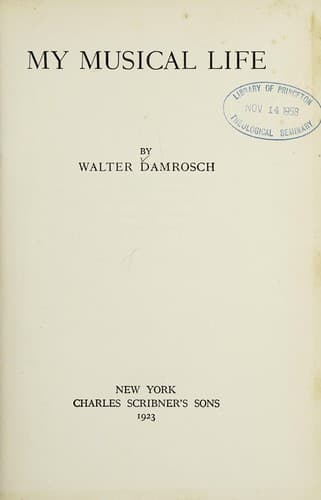
Conductors (Music) -- United States -- Biography; Damrosch, Walter, 1862-1950
Ignace Paderewski made his first appearance in America in 1891, and I
conducted his first five orchestral concerts. He came under the auspices
of Steinway and Sons, and they told me that the gross receipts for the
first concert were only five hundred dollars! His playing as well as his
personality, however, immediately took our public by storm, and I do not
think that since the days of Franz Liszt there has been any other
travelling virtuoso in whom the man was as fascinating as the artist.
People who have wondered how it was possible for him when the Great War
began to throw himself so fully equipped at every point into the
struggle to achieve national unity for Poland, do not realize that he
was, consciously or unconsciously, preparing himself for just this
opportunity all his life. He had always dreamed of a united and
independent Poland. He knew the history of his people, their strength,
and their weakness. It is said that one day he played before the Czar
who, congratulating him, expressed his pleasure that a “Russian” should
have achieved such eminence in his art. Paderewski answered: “I am a
Pole, your Majesty,” and, needless to say, was never again invited to
play in Russia. His mind is one of the most extraordinary I have ever
come in contact with. All the world knows what he has achieved in
music—his inspired interpretations, his prodigious memory, and the
subtle range of colors of his musical palette, but not so many know of
his interest in literature, philosophy, and history, and it took the
Great War to demonstrate that as orator and statesman he ranks as high
as musician. I heard him make a speech on Poland during the Exposition
in San Francisco in 1915 before an audience of ten thousand, in which he
gave so eloquent a survey of Poland’s history and of her needs and
rights, as to rouse the people to a frenzy of enthusiasm, and I am
convinced that Poland owes her national existence to-day to his
statesmanship and to the sympathy which his personality created among
the Allies at the Versailles Conference. I believe that Colonel House
pronounced him to be the greatest statesman of the Conference, and it
was only the cynical Clemenceau who said to him: “M. Paderewski, you
were the greatest pianist in the world and you have chosen to descend to
our level. What a pity!”
When he first came to America, his English was very incomplete but even
then he demonstrated his grasp of it in unmistakable fashion. One
evening he, my wife, and I dined at the house of very dear mutual
friends, Mr. and Mrs. John E. Cowdin, in Gramercy Park. Cowdin had all
his life been an enthusiastic polo player, and after dinner Paderewski
and I admired some handsome silver trophies that he had won and that
were placed in the dining-room. I said: “You see the difference between
you and Johnny is that he wins his prizes in playing polo while you win
yours in playing solo.”
Public-domain text, read in full here on John Shaqi.
Reviews
Reviews
No reviews yet
Be the first to share your thoughts on this work.
Elsewhere in the archive
Join the Discussion
Join the discussion
Sign in to leave a comment or review.
Sign InorCreate an account