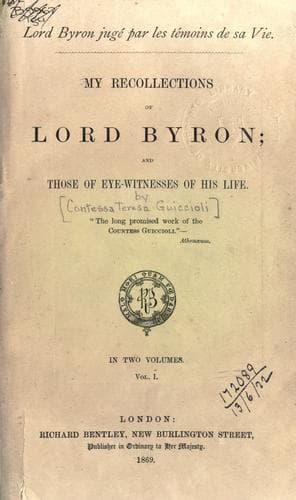
My Recollections of Lord ByronGuiccioli, Teresa, contessa di
General
My Recollections of Lord Byron
Guiccioli, Teresa, contessa di
Byron, George Gordon Byron, Baron, 1788-1824; Poets, English -- 19th century -- Biography
But he might have found at Pisa the great intellectual influence spoken
of, for he found Shelley there. Seeing him every day, in the quiet
intimacy which the delightful sojourn in Tuscany procured for them, it
was easy for both to forget all the troubles of an agitated and
political existence, and only to think about the world of spirits.
Shelley had every opportunity for inculcating his doctrines, having, or
rather being able to exercise, the most exclusive influence upon Byron's
mind. Did he exercise that influence, and if he did not, for what
reason?
We have said that Shelley, notwithstanding his original views, his
extreme readiness to be impressed by every thing he heard and saw, was
often the victim of his reading. He had read a great deal, and though
since he had written the "Apology for Atheism" he had not changed his
mind as to his metaphysical tenets, nevertheless the study of the German
philosophy, and especially of Spinoza's, had produced on him a
revolution of ideas. From a materialistic atheism, which denies the
existence of God in every thing, he had gone over to a kind of mystic
pantheism, which supposes God to be everywhere and in every thing. This
species of pantheism is in reality but a disguised atheism, but which,
in such a man as Shelley, appeared more in the actions of his life as a
pervading devotion than an impious belief. Shelley ever adored all that
is beautiful, true, and holy. From this it followed that his doctrines,
far from appearing to be the result of pride, seemed, on the contrary,
to be founded upon humility, sacrifice, and devotion to humanity. If the
mystic pantheism of Spinoza could have found a living justification of
its silly principles, and an excuse for its want of power, Shelley would
have supplied both. The individuality, always more or less egotistical,
which is prominent in the word _ego_, seemed positively to have ceased
to exist with him: one would have said that he almost already felt
himself absorbed in that universal and divine substance, which is the
God of Spinoza. If in a century like ours such a philosophy as
Eclecticism could return and become again a doctrinal institution,
Shelley might have personified it. He had so sacrificed his
individuality to chimeras of all kinds, that he appeared to consider
himself a mere phenomenon, and to look upon the external world as mere
fiction, in order that the impossible and never-to-be-found divinity of
his dreams might occupy all the space.
He was perhaps the meekest, most generous, and the most modest of the
creatures of the true God, whom he yet persistently refused to recognize
as his Creator.
If, however, there was no impiety in his irreligion, no real pride, in
his pride, there existed that weakness, if I may use the word, peculiar
to a brain which can not grasp at reality, but adheres to a chimera as a
basis for its arguments.
Public-domain text, read in full here on John Shaqi.
Reviews
Reviews
No reviews yet
Be the first to share your thoughts on this work.
Elsewhere in the archive
Join the Discussion
Join the discussion
Sign in to leave a comment or review.
Sign InorCreate an account