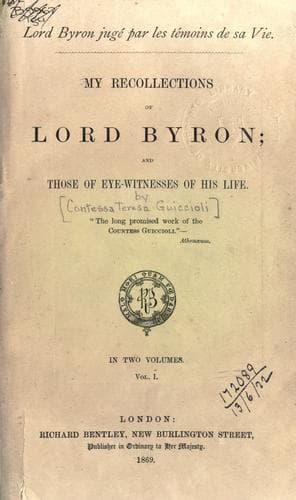
My Recollections of Lord ByronGuiccioli, Teresa, contessa di
General
My Recollections of Lord Byron
Guiccioli, Teresa, contessa di
Byron, George Gordon Byron, Baron, 1788-1824; Poets, English -- 19th century -- Biography
"His works," says Galt, "are soiled by the false judgments proceeding
from a mind which made him look at every thing in a false light, and it
must be allowed that that mind was either troubled or defective by
nature."
If this opinion is too severe, it is, however, certain that Shelley had
so exalted an imagination that his judgment suffered by it. As he is in
his works, so was he in all the commonest actions of his life. A few
anecdotes will serve to make him still better known.
Once, at Pisa, he went to see Count Gamba, who expected him, for some
charitable purpose which they were to agree upon together. A violent
storm burst forth suddenly, and the wind tore a tile from a roof, and
caused it to fall on Shelley's head. The blow was very great, and his
forehead was covered with blood. This, however, did not in the least
prevent his proceeding on his way. When Count Gamba saw him in this
state he was much alarmed, and asked him how it had occurred. Shelley
replied quite calmly, passing his hand over his head, just as if he had
forgotten all about it, that it was true that the wind had blown down a
tile which had fallen on his head, but that he would be taken care of
later upon his return home. Shelley was not rich, but whenever he went
to his banker's it was necessary that no one should require his
assistance, in order that the money which he had gone to fetch should
come home untouched. As, on one occasion, he was returning from a visit
to his banker's, some one at the door of his house asked for assistance.
Shelley hastily got up the stairs, and throwing down his gold and notes
on the floor, rushed suddenly away, crying out to Mrs. Shelley, "There,
pick it all up." This the lady did as well as she could, for she was a
woman of order, and as much attached to the reality of things as her
husband was wanting in that particular.
I shall not multiply these characteristic instances of the man, but will
only add that such incidents were by no means uncommon, nay, that they
were matters of daily occurrence.
There was almost a kind of analogy in his life between him and Spinoza.
Notwithstanding their great qualities and merits, both were hated and
persecuted for sufficiently just motives,--society having the right of
repudiating doctrines which tend to its destruction; but both were
persecuted in undue and unfair proportions. Both had weak and sickly
constitutions. Both had great and generous souls. Both endeavored to
understand the laws which govern the destiny of the world, without ever
being subject to their moral consequences, and both devoted themselves
to be practically useful to their fellow-creatures--a contradiction
which was the effect of their too generous minds.
Public-domain text, read in full here on John Shaqi.
Reviews
Reviews
No reviews yet
Be the first to share your thoughts on this work.
Elsewhere in the archive
Join the Discussion
Join the discussion
Sign in to leave a comment or review.
Sign InorCreate an account