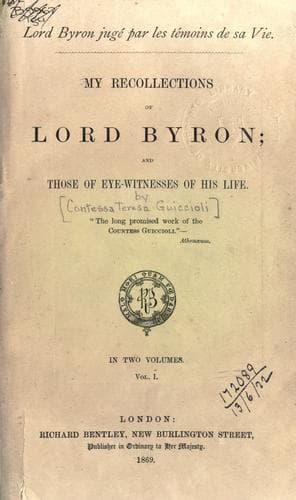
My Recollections of Lord ByronGuiccioli, Teresa, contessa di
General
My Recollections of Lord Byron
Guiccioli, Teresa, contessa di
Byron, George Gordon Byron, Baron, 1788-1824; Poets, English -- 19th century -- Biography
Even in "Don Juan," in that admirable satire which, not being rightly
understood, has given rise to so many calumnies, he says, after having
spoken in the fifteenth canto of the moral greatness of various men, and
among others of Socrates:--
"And thou, Diviner still,
Whose lot it is by man to be mistaken,
And thy pure creed made sanction of all ill?
Redeeming worlds to be by bigots shaken,
How was thy toil rewarded?"
At the end of this stanza he wrote the following note:----
"As it is necessary in these times to avoid ambiguity, I say that I mean
by 'Diviner still,' Christ. If ever God was man--or man God--he was
both. I never arraigned his creed, but the use or abuse made of it. Mr.
Canning one day quoted Christianity to sanction negro slavery, and Mr.
Wilberforce had little to say in reply. And was Christ crucified that
black men might be scourged? If so, he had better been born a mulatto,
to give both colors an equal chance of freedom, or at least salvation."
Notwithstanding these beautiful lines, which were equally professions of
faith, England, instead of doing Byron justice, continued more than ever
to persecute him.
Shortly afterward he embarked at Genoa for Greece, and halted at
Cephalonia. He there made the acquaintance of a young Scotchman, named
Kennedy, who was attached as doctor to the Greek army. Before taking to
medicine this young man had studied law, with the intention of going to
the Edinburgh bar. He was so deeply convinced of the truths of
Christianity, and so familiar with its teaching, that he would fain have
imparted his belief to every one he met. From his position he found
himself among a host of young officers, mostly Scotch, and all more or
less lax in their religious practices. Among these, however, he met with
four who consented to listen to his explanation of the doctrines of
Christianity. As their principal challenge was to show proofs that the
Bible was of divine origin, he accepted the challenge in the hope of
making some conversions.
One of these officers informed Lord Byron of this projected meeting, and
Byron, from the interest which he always took in the subject which was
to be their ground of discussion, expressed a wish to be present. "You
know," said he, "that I am looked upon as a black sheep, and yet I am
not as black as the world makes me out, nor worse than others,"--words,
which, from the fact of his rarely doing himself justice, were
noteworthy in his mouth.
Under such auspices, then, was Kennedy fortunate enough to open his
discussion, and Lord Byron was present in company of the young Count
Gamba and Dr. Bruno.
Public-domain text, read in full here on John Shaqi.
Reviews
Reviews
No reviews yet
Be the first to share your thoughts on this work.
Elsewhere in the archive
Join the Discussion
Join the discussion
Sign in to leave a comment or review.
Sign InorCreate an account