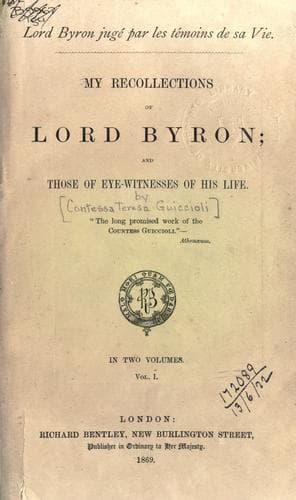
My Recollections of Lord ByronGuiccioli, Teresa, contessa di
General
My Recollections of Lord Byron
Guiccioli, Teresa, contessa di
Byron, George Gordon Byron, Baron, 1788-1824; Poets, English -- 19th century -- Biography
Poor Shelley lost his time with Byron. But, however much Byron objected
to his doctrines, he had no similar objection to Shelley himself, for
whom he professed a great respect and admiration. He grieved to find so
noble an intellect the victim of hallucination which entirely blinded
him to the perception of truth. Shelley, however, did not despair of
succeeding in making Byron some day give up what he termed his
philosophical errors, and his persistency earned for him the appellation
of "serpent" which Byron gave him in jest. This persistency, which at
the same time indicates the merit of Byron's resistance, has often been
mentioned by Shelley himself. Writing from Pisa to a friend in England,
a very few days before his death, and alluding to a letter from Moore
which Byron had shown him, and wherein "Cain" was attributed to the
influence which he (Shelley) had evidently exercised over Byron, he
said, "Pray assure Moore that in a philosophical point of view I have
not the slightest influence over Byron; if I had, be sure I should use
it for the purpose of uprooting his delusions and his errors. He had
conceived 'Cain' many years ago, and he had already commenced writing it
when I saw him last year at Ravenna. How happy I should be could I
attribute to myself, even indirectly, a part in that immortal work!"
Moore wrote to Byron on the same subject a little later, and received
the following reply:--"As for poor Shelley, who also frightens you and
the world, he is, to my knowledge, the least egotistical and kindest of
men. I know no one who has so sacrificed both fortune and sentiments for
the good of others; as for his speculative opinions, we have none in
common, nor do I wish to have any."
All the poems which he wrote at this time, and which admitted of his
introducing the religious element either purposely or accidentally into
them, prove one and all that his mind, as regards religion, was as we
have shown it to be. This is particularly noticeable in his mystery
called "Heaven and Earth;" but the same remark is applicable to others,
such as the "Island," and even to some passages in "Don Juan." "Heaven
and Earth"--a poem which appeared about this time, and which he styled
"A Mystery"--is a biblical poem in which all the thoughts agree with the
Book of Genesis, and "which was inspired," says Galt, "by a mind both
serious and patriarchal, and is an echo of the oracles of Adam and of
Melchisedec." In this work he exhibits as much veneration for scriptural
theology as Milton himself. In the "Island," which he wrote at Genoa,
there are passages which penetrate the soul with so religious a feeling,
that Benjamin Constant, in reading it, and indignant at hearing Byron
called an unbeliever, exclaimed in his work on religion, "I am assured
that there are men who accuse Lord Byron of atheism and impiety. There
is more religion in the twelve lines which I have quoted than in the
past, present, and future writings of all his detractors put together."
Public-domain text, read in full here on John Shaqi.
Reviews
Reviews
No reviews yet
Be the first to share your thoughts on this work.
Elsewhere in the archive
Join the Discussion
Join the discussion
Sign in to leave a comment or review.
Sign InorCreate an account