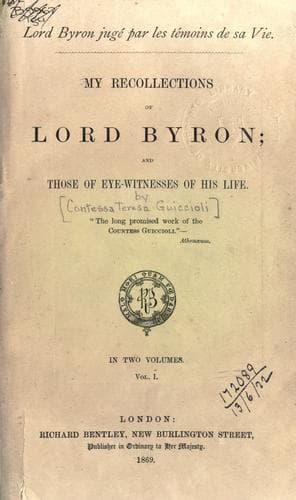
My Recollections of Lord ByronGuiccioli, Teresa, contessa di
General
My Recollections of Lord Byron
Guiccioli, Teresa, contessa di
Byron, George Gordon Byron, Baron, 1788-1824; Poets, English -- 19th century -- Biography
He then went into his bedroom, and brought out a handsomely-bound pocket
Bible which he showed the doctor. The latter advised his continuing to
read it, but expressed his surprise that Byron should not have better
understood it. He looked out several passages in which it is enjoined
that we should pray with humility if we wish to understand the truth of
the Gospel; and where it is expressly said that no human wisdom can
fathom these truths; but that God alone can reveal them to us, and
enlighten our understanding; that we must not scrutinize His acts, but
be submissive as children to His will; and that, as obedience through
the sin of our first parents, and our own evil inclinations, has become
for us a positive difficulty, we must change our hearts before we can
obey or take pleasure in obeying the commandments of our Lord God; and,
finally, that all, whatever the rank of each, are subject to the
necessity of obedience.
Byron's occupations and ideas at that time were not quite in accordance
with the nature of these holy words, but he received them with his usual
kind and modest manner, because they came from one who was sincere. He
only replied, that, as to the wickedness of the world, he was quite of
his opinion, as he had found it in every class of society; but that the
doctrines which he had put forth would oblige him to plunge into all the
problems respecting the Old Testament and original sin, which many
learned persons, as good Christians as Dr. Kennedy, did not hesitate to
reject. He then showed the doctor, in answer to the latter's rather
intolerant assertion of the omnipotence of the Bible, how conversant he
was with the subject by quoting several Christian authors who thought
differently. He quoted Bishop Watson, who, while professing
Christianity, did not attribute such authority to the contents of the
Bible. He also mentioned the Waldenses, who were such good Christians
that they were called "the true Church of Christ," but who,
nevertheless, looked upon the Bible as merely the history of the Jews.
He then showed that the Book of Genesis was considered by many doctors
of divinity as a mere symbol or allegory. He took up the defense of
Gibbon against Kennedy's insinuation that the great historian had
maliciously and intentionally kept back the truth; he quoted Warburton
as a man whose ingenious theories have found much favor with many
learned persons; finally, he proved to the doctor that, in any case, he
could not himself be accused of ignorance of the subject.
This conversation afforded him the opportunity also of refuting the
accusation brought against him by some of his numerous enemies; namely,
that of having a tendency to the doctrines of Manicheism. Kennedy having
said that the spirit of evil, as well as the angels, is subject to the
will of God, Lord Byron replied,----
Public-domain text, read in full here on John Shaqi.
Reviews
Reviews
No reviews yet
Be the first to share your thoughts on this work.
Elsewhere in the archive
Join the Discussion
Join the discussion
Sign in to leave a comment or review.
Sign InorCreate an account