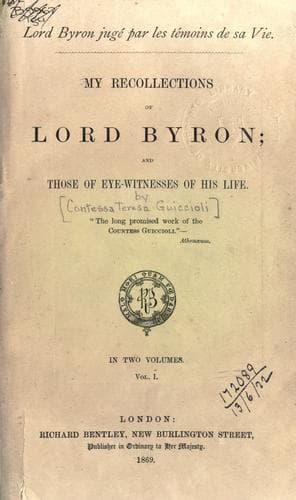
My Recollections of Lord ByronGuiccioli, Teresa, contessa di
General
My Recollections of Lord Byron
Guiccioli, Teresa, contessa di
Byron, George Gordon Byron, Baron, 1788-1824; Poets, English -- 19th century -- Biography
"If received in a literal sense, I find that it gives one a far higher
notion of God's majesty, power, and wisdom, if we believe that the
spirit of evil is really subject to the will of the Almighty, and is as
easily controlled by Him as the elements follow the respective laws
which He has made for them."
Byron could not bear any thing which took away from the greatness of the
Divinity, and his words all tended to replace the Divinity in that
incomprehensible space where He must be silently acknowledged and
adored. Their conversation extended to other points of religious belief.
While the doctor, taking the Bible to be the salvation of mankind,
indulged in exaggerated and intolerant condemnation of the Catholic
Church, which he called an abominable hierarchy not less to be regretted
than Deism and Socinianism, Byron again displayed a spirit of toleration
and moderation. Though he disapproved of the doctor's language, he did
not contradict him, believing him to be sincere in his recriminations,
but brought back the conversation to that point from which common sense
should never depart. He deplored with him existing hypocrisies and
superstitions, which he looked upon as the cause of the unbelief of many
in the existence of God; but he added, that it was not confined to the
Continent only, but likewise existed in England. Instead of resting his
hopes upon the Bible, he said that he knew the Scriptures well enough
"to be sure that if the spirit of meekness and goodness which the
religion of the Gospel contains were put into practice by men, there
would certainly be a marvellous change in this wicked world;" and he
finished by saying, that as for himself he had, as a rule, ever
respected those who believed conscientiously, whatever that belief might
be; in the same manner as he detested from his heart hypocrites of all
kinds, and especially hypocrites in religion.
He then changed the topic of conversation, and turned it to literature.
All he said on that subject is so interesting that I reserve the record
of it to another chapter. The doctor, however, soon resumed the former
subject of their conversation, and, more in the spirit of a missionary
than a philosopher, he went on to recommend the study of Christianity,
which he said was summed up entirely in the Scriptures.
"But what will you have me do?" said Byron. "I do not reject the
doctrines of Christianity, I only ask a few more proofs to profess them
sincerely. I do not believe myself to be the vile Christian which
many--to whom I have never done any harm, and many of whom do not even
know me--strenuously assert that I am, and attack me violently in
consequence."
The doctor insisted.
"But," said Byron, "you go too fast. There are many points still to be
cleared up, and when these shall have been explained, I shall then
examine what you tell me."
Public-domain text, read in full here on John Shaqi.
Reviews
Reviews
No reviews yet
Be the first to share your thoughts on this work.
Elsewhere in the archive
Join the Discussion
Join the discussion
Sign in to leave a comment or review.
Sign InorCreate an account