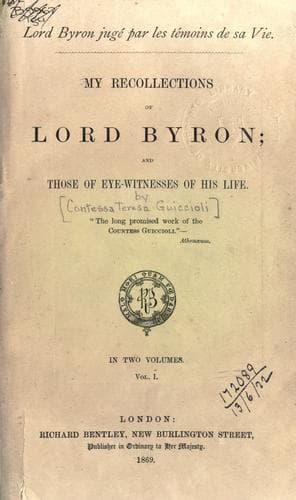
My Recollections of Lord ByronGuiccioli, Teresa, contessa di
General
My Recollections of Lord Byron
Guiccioli, Teresa, contessa di
Byron, George Gordon Byron, Baron, 1788-1824; Poets, English -- 19th century -- Biography
"What are those difficulties?" replied the doctor. "If the subject is
important, why delay its explanation? You have time; reason upon it;
reflect. You have the means of disposing of the difficulty at your
command."
"True," answered Byron, "but I am the slave of circumstances, and the
sphere in which I live is not likely to make me consider the subject."
As the doctor became more urgent, Byron said----
"How will you have me begin?"
"Begin this very night to pray God that he may forgive you your sins,
and may grant you grace to know the truth. If you pray, and read your
Bible with purity of intention, the result must be that which we so
ardently wish for."
"Well, yes," replied Byron, "I will certainly study these matters with
attention."
"But your lordship must bear in mind, that you should not be
discouraged, even were your doubts and difficulties to increase; for
nothing can be understood without sufficient time and pains. You must
weigh conscientiously each argument, and continue to pray to God, in
whom at least you believe, to give you the necessary understanding."
"Why then," asked Byron, "increase the difficulties, when they are
already so great?"
The doctor then took the mystery of the Trinity as an example, and
spoke of it as a man who has faith and accepts the mystery as a revealed
dogma.
"It is not the province of man," said he, "to comprehend or analyze the
nature of an existence which is entirely spiritual, such as that of the
Divinity; but we must accept it, and believe in it, because it has been
revealed to us, being fully convinced that man in his present state will
never be able to fathom such mysteries."
He not only blamed those who wish to explain all things, but likewise
the presumption of certain theologians in mixing up their own arguments
with the revelations of Scripture in order to prove the unity in the
Trinity, and who speculate upon the attributes of the Deity to ascertain
the relative mode of existence of each of the three persons who compose
the Trinity. "They must fall," he added, "or lead others to a similar
end." Hence he concluded that mysteries should be believed in
implicitly, as children believe fully what their parents tell them.
"I therefore advise your lordship," said he, "to put aside all difficult
subjects,--such as the origin of sin, the fall of man, the nature of the
Trinity, the mystery of predestination, etc.,--and to study Christianity
not in books of theology, which, even the best, are all more or less
imperfect, but in the careful examination of the Scriptures. By
comparing each part of it, you will at last find a harmony so great in
all its constituent parts, and so much wisdom in its entire whole, that
you will no longer be able to doubt its divine origin, and hence that it
contains the only means of salvation."
To so firm and enviable a faith, Byron replied as follows:--
Public-domain text, read in full here on John Shaqi.
Reviews
Reviews
No reviews yet
Be the first to share your thoughts on this work.
Elsewhere in the archive
Join the Discussion
Join the discussion
Sign in to leave a comment or review.
Sign InorCreate an account