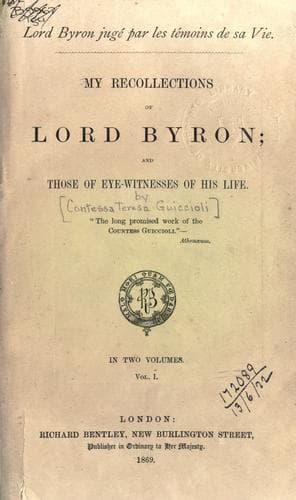
My Recollections of Lord ByronGuiccioli, Teresa, contessa di
General
My Recollections of Lord Byron
Guiccioli, Teresa, contessa di
Byron, George Gordon Byron, Baron, 1788-1824; Poets, English -- 19th century -- Biography
"You seem to hate the Socinians greatly," remarked Byron, "but is this
charitable? Why exclude a Socinian, who believes honestly, from any hope
of salvation? Does he not also found his belief upon the Bible? It is a
religion which gains ground daily. Lady Byron is much in favor with its
followers. We were wont to discuss religious matters together, and many
of our misunderstandings have arisen from that. Yet, on the whole, I
think her religion and mine were much alike."
Of course the doctor deplored the existence of such bold doctrines.
Lord Byron then spoke of Shelley:--
"I wish," he said, "you had known him, and that I might have got you
both together. You remind me of him, not only in looks, but by your
manner of speaking."
Besides physical appearance, it is easy to understand that there existed
a great likeness between the two minds, different though their moral
tendencies might have been. In both could be traced that degree of
mysticism and expansiveness, which make the poet and the missionary.
Byron praised the virtues of Shelley, and styled them Christian, and
spoke mainly of his great benevolence of character, and of his
generosity above his means.
"Certainly," replied the doctor, "such rare virtues are esteemed among
Christians, but they can not be called Christian virtues, unless they
spring from Christian principles: and in Shelley they were not so. His
virtues might deserve human praise, they were no doubt pagan virtues;
but they were nothing in the eyes of God, since God has declared that
nothing pleases Him but that which springs from a good motive,
especially the love of and belief in Christ, which was wanting in
Shelley."
When Kennedy had characterized Shelley in even stronger terms, Byron
said to him: "I see it is impossible to move your soul to any sympathy,
or even to obtain from you in common justice a little indulgence for an
unfortunate young man, gifted with a lofty mind and a fine imagination."
These remarks reveal the tolerant spirit of Lord Byron, but they also
show how the best natures are spoiled by dogmatism.
The conversation had lasted several hours. Night was coming on, and the
doctor, carried away by his zeal, had forgotten the hour. His host,
however, did nothing to remind him of it, and when Kennedy got up to
take his leave, he said to Byron, after making excuses for remaining so
long, "God having gifted you, my lord, with a mind which can grasp every
subject, I am convinced that if your lordship would devote yourself to
the study of religion, you would become one of its lights, the pride of
your country, and the consolation of every honest person."
Lord Byron replied:--
"I certainly intend to study the matter, but you must give me a little
time. You see that I have begun well: I listen to all you say. Don't you
find that my arguments are more like your own than you would have
thought?"
Public-domain text, read in full here on John Shaqi.
Reviews
Reviews
No reviews yet
Be the first to share your thoughts on this work.
Elsewhere in the archive
Join the Discussion
Join the discussion
Sign in to leave a comment or review.
Sign InorCreate an account