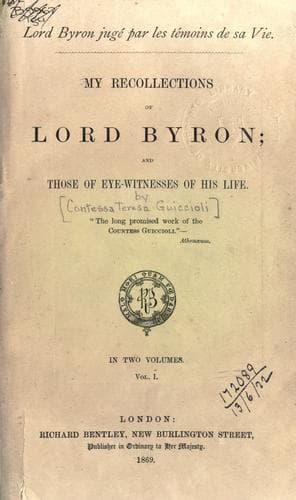
My Recollections of Lord ByronGuiccioli, Teresa, contessa di
General
My Recollections of Lord Byron
Guiccioli, Teresa, contessa di
Byron, George Gordon Byron, Baron, 1788-1824; Poets, English -- 19th century -- Biography
"Yes," answered the doctor, "and it gives me great pleasure. I have far
better hopes of your lordship's conversion than of that of the young
officers who listened to me without understanding the meaning of my
words. You have shown greater patience and candor than I could have
imagined you to be capable of; whereas they, on the contrary, exhibited
so hardened a spirit that they appeared to look upon the subject as one
which lent itself admirably to ridicule and laughter."
"You must allow," said Byron, "that in the times in which we are now
living it is difficult to bestow attention to any serious religious
matter. I think, however, I can promise to reflect even more on the
subject than I have done hitherto, without, however, promising to adopt
your orthodox views."
The doctor then asked him leave to present him with the work of B----,
which he commended in high terms. Lord Byron said he would have great
pleasure in reading it, and told the doctor that he should always be
happy to see him, and at any time that he liked to come. "Should I be
out when you come," he added, "take my books and read until my return."
On leaving Byron the doctor reflected over all that had taken place, and
feared that his zeal had carried him too far--that his long conversation
might have tired rather than interested Byron; but on the whole, he
concluded by saying to himself, "It appears to me, that Byron never
exhibited the least symptom of fatigue, but, on the contrary,
continually showed great attention from beginning to end."
We have, perhaps, dwelt too much in our report of this conversation, but
we wished to do so for several reasons. First, because it shows, better
than a public debate, the real thoughts and feelings of Byron on
religious matters, next, the real nature of his religious opinions, and
finally we find, in Byron's conversation, virtues such as amiability,
goodness, patience, delicacy, and toleration, which have not been
sufficiently noticed.
The sympathy which Kennedy had conceived for Byron after the public
meeting greatly increased after this first conversation. The candor and
simplicity depicted on his handsome countenance, showed that his lofty
intelligence could, better than any one else, grasp the theories of the
doctor; and the latter felt that if he could not prevail in making Byron
a believer in his own orthodox views, at least he could prepare the way
for the acquirement of every virtue, and he resolved, therefore, to
profit by the permission given him of often visiting Byron.
Meanwhile, the young officers continued their jokes, and pretended that
Byron was laughing at the doctor, and making use of him in order to
study Methodism, which he wished to introduce into his poem of "Don
Juan." There is, however, a community of feeling between two frank
natures, and Byron felt that the doctor's sincerity commanded respect,
while the doctor, on the other hand, knew that Lord Byron was too
earnest to condescend to a mockery of him.
Public-domain text, read in full here on John Shaqi.
Reviews
Reviews
No reviews yet
Be the first to share your thoughts on this work.
Elsewhere in the archive
Join the Discussion
Join the discussion
Sign in to leave a comment or review.
Sign InorCreate an account