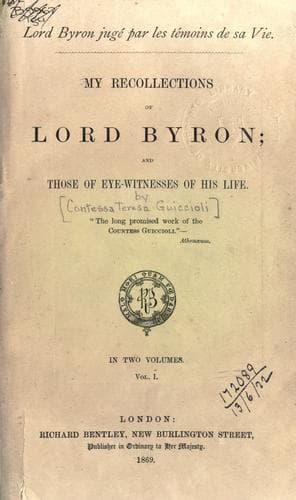
My Recollections of Lord ByronGuiccioli, Teresa, contessa di
General
My Recollections of Lord Byron
Guiccioli, Teresa, contessa di
Byron, George Gordon Byron, Baron, 1788-1824; Poets, English -- 19th century -- Biography
"This may be true," said Kennedy, "but the question is, what are your
motives and object for painting nothing but scenes of vice and folly?"
"To remove the cloak which the manners and maxims of society," said his
lordship, "throw over their secret sins, and show them to the world as
they really are. You have not," added he, "been so much in high and
noble life as I have been; but if you had fully entered into it, and
seen what was going on, you would have felt convinced that it was time
to unmask the specious hypocrisy, and show it in its native colors!"
Kennedy having then remarked that the lower and middling classes of
society never entertained the opinion that the highest classes exhibited
models of piety and virtue, and were, indeed, disposed to believe them
worse than they really were, Byron replied:--
"It is impossible you can believe the higher classes of society worse
than they are in England, France, and Italy, for no language can
sufficiently paint them."
"But still, my lord, granting this, how is your book calculated to
improve them, and by what right, and under what title do you too come
forward in this undertaking?"
"By the right," he replied, "which every one has who abhors vice united
with hypocrisy. My plan is to lead Don Juan through various ranks of
society and show that wherever you go vice is to be found."
The doctor then observed, that satire had never done any good, or
converted one man from vice to virtue, and that while his satires were
useless, they would call upon his head the disapproval both of the
virtuous and the wicked.
"But it is strange," answered Byron, "that I should be attacked on all
sides, not only from magazines and reviews, but also from the pulpit.
They preach against me as an advocate of infidelity and immorality, and
I have missed my mark sadly in having succeeded in pleasing nobody. That
those whose vices I depicted and unmasked should cry out is natural, but
that the friends of religion should do so is surprising: for you know,"
said he, smiling, "that I am assisting you in my own way as a poet, by
endeavoring to convince people of their depravity; for it is a doctrine
of yours--is it not?--that the human heart is corrupted; and therefore
if I show that it is so in those ranks which assume the external marks
of politeness and benevolence,--having had the best opportunities, and
better than most poets, of observing it,--am I not doing an essential
service to your cause, by first convincing them of their sins, and thus
enabling you to throw in your doctrine with more effect?"
"All this is true," said Kennedy; "but you have not shown them what to
do, however much you may have shown them what they are. You are like the
surgeon who tears the bandages from the numerous wounds of his ulcerated
patients, and, instead of giving fresh remedies, you expose them to the
air and disgust of every bystander, who, laughing, exclaims, 'How filthy
these fellows are!'"
Public-domain text, read in full here on John Shaqi.
Reviews
Reviews
No reviews yet
Be the first to share your thoughts on this work.
Join the Discussion
Join the discussion
Sign in to leave a comment or review.
Sign InorCreate an account